Showing posts with label Paul Dehn. Show all posts

Friday, October 29, 2010

007 In Depth: Conventional Thinking

In Austin Powers: International Man of Mystery (1997), villainous mastermind Dr Evil captures Austin Powers, who he then introduces to his son, Scott:
'Dr. Evil: Scott, I want you to meet Daddy’s nemesis, Austin Powers.
Scott Evil: What? Are you feeding him? Why don’t you just kill him?
Dr. Evil: I have an even better idea. I’m going to place him in an easily escapable situation involving an overly elaborate and exotic death.'
This is an obvious parody of James Bond, and raises a laugh for that reason. One of the best-known examples of such a scene takes place in Goldfinger, in which Bond is captured by the eponymous super-villain, a gold-smuggler said to be ‘the richest man in England’. In the novel, published in 1959, Bond is bound to a table and threatened with a buzz saw:
'Bond glanced down the table on which he lay spread-eagled. He let his head fall back with a sigh. There was a narrow slit down the centre of the polished steel table. At the far end of the slit, like a foresight framed in the vee of his parted feet, were the glinting teeth of a circular saw…'1
Bond, increasingly desperate as the saw approaches his body, suggests that he and his companion Tilly Masterton could work for Goldfinger. The offer is rejected:
'Bond said politely, ‘Then you can go and —— yourself.’ He expelled all the breath from his lungs and closed his eyes.

‘Even I am not capable of that, Mr Bond,’ said Goldfinger with good humour. ‘And now, since you have chosen the stony path instead of the smooth, I must extract what interest I can from your predicament by making the path as stony as possible...’'2
But then, on a whim, Goldfinger changes his mind. He decides he does need a couple of assistants after all, and shuts off the saw.

When it came to adapting the book for film, this scene proved problematic for the scriptwriters. The first problem was the one that Austin Powers poked fun at: why would a villain go to such extravagant lengths to kill the hero when it would be much simpler (and safer) to just shoot him through the head? Secondly, how does Bond get out of the situation? Fleming’s solution seemed highly implausible, and might elicit groans from a cinema audience. And finally, the entire set-up was a cliché: along with being tied to train tracks, such scenes had been a staple of the early radio and film serials, pulps and cartoons. In Columbia Pictures’ Captain Midnight in 1942, for example, the titular hero finds himself on a log rapidly heading towards a buzz saw, while in the 1933 Disney cartoon The Mad Doctor, Mickey Mouse has an extended nightmare in which he is strapped to an operating table by a Doctor XXX before a spinning saw descends from the ceiling to cut him in two.


While he was working on the treatment for Goldfinger in April 1963, Richard Maibaum wrote to the film’s producers, Cubby Broccoli and Harry Saltzman, to explain his solution to this problem:
'That BUZZ SAW in the torture scene must go. It’s the oldest device in cheap melodrama. The villain strapping the heroine to a work bench, etc. It’s comic by now. Instead, I am dreaming up a machine which utilizes the new LASER BEAM. It was featured in LIFE magazine and I have sent for the article to send on to you. It’s a coiled light around an oblong-shaped ruby. When the light is turned on a beam of red light is emitted from the ruby. A ten-thousandth of a second exposure to the beam can remove a cancer. It also can be used, when developed, to cut steel, etc. I visualize a demonstration of the beam, from an overhead contraption hanging from rails on the ceiling, showing it cutting through steel like a razor through paper. And then used, as the buzz saw was in the book, threatening to cut Bond in half. The beam will look like a fiery red concentrated thin long blade emerging straight down from the contraption overhead, coming closer, closer. With the same electrical whine as the saw would have. This out-Flemings Fleming. Using the very latest scientific discovery in the old way of scaring the wits out of people.'3
The futuristic extravagance of the laser beam distracted from the fact that the essence of the scene remained the same, with the same problems: there seemed no reason for Goldfinger not to just shoot Bond, no reason to spare him, and equally no way for Bond to plausibly escape from the table. Maibaum and Paul Dehn, who was called in to work on the script, both struggled with these problems. Eventually, Dehn worked out a solution whereby Bond overhears Goldfinger refer to ‘Operation Grand Slam’ earlier, and by mentioning it piques the villain’s interest and fear enough to have him shut off the machine. Dehn also added the famous dialogue in the scene:
'Bond: Do you expect me to talk?
Goldfinger: No, Mr Bond, I expect you to die!'
Goldfinger was the film that made James Bond a global phenomenon. As a result, this scene is popularly regarded as the prototype of the villain arranging an elaborate death for the captured hero, as parodied in Austin Powers and elsewhere. But this convention doesn’t simply predate Goldfinger: it was so common that it was already being parodied decades before the novel and film were released. In Leslie Charteris’ 1930 novel Knight Templar (later retitled The Avenging Saint), Simon Templar renews battle with villainous mastermind Dr Rayt Marius. In the third act, Marius captures The Saint, who sardonically remarks that he hopes Marius has invented a ‘picturesque’ way for him to die:
'‘It is certainly necessary for you to die, Templar,’ said Marius dispassionately. ‘There is a score between us that cannot be settled in any other way.’
The Saint nodded, and for a moment his eyes were two flakes of blue steel.
‘You’re right, Angel Face,’ he said softly. ‘You’re dead right… This planet isn’t big enough to hold us both. And you know as surely as you’re standing there that if you don’t kill me I’m going to kill you, Rayt Marius!’
‘I appreciate that,’ said the giant calmly.
And then the Saint laughed.
‘But still we have to face the question of method, old dear,’ he murmured, with an easy return of all his old mocking banter. ‘You can’t wander round England bumping people off quite so airily. I know you’ve done it before – on one particular occasion – but I haven’t yet discovered how you got away with it. There are bodies to be got rid of, and things like that, you know – it isn’t quite such a soft snap as it reads in story-books. It’s an awful bore, but there you are. Or were you just thinking of running us through the mincing machine and sluicin’ the pieces down the kitchen sink?’
Marius shook his head.
‘I have noticed,’ he remarked, ‘that in the stories to which you refer, the method employed for the elimination of an undesirable busybody is usually so elaborate and complicated that the hero’s escape is as inevitable as the reader expects it to be. But I have not that melodramatic mind. If you are expecting an underground cellar full of poisonous snakes, or a trap-door leading to a subterranean river, or a man-eating tiger imported for your benefit, or anything else so conventional – pray disillusion yourself. The end I have designed for you is very simple. You will simply meet with an unfortunate accident – that is all.’
He was carefully trimming the end of his cigar as he spoke; and his tremendous hands moved to the operation with a ruthless deliberation that was more terrible than any violence.'4
This is essentially the same gag as the one in Austin Powers, only 67 years earlier – and 23 years before James Bond was created. Charteris was poking fun at well-established thriller conventions, and also at himself, as he had used many of them. But he also made sure not to undermine the idea so much that he couldn’t use similar plot devices later:
'The Saint knew as well as anyone that the blood-curdling inventions of the sensational novelist had a real foundation in the mentality of a certain type of crook, that there were men constitutionally incapable of putting the straightforward skates under an enemy whom they had in their power – men whose tortuous minds ran to electrically fired revolvers, or tame alligators in a private swimming bath, as inevitably as water runs downhill. The Saint had met this type of man.'5

Knight Templar features several other conventions now associated with James Bond. In the novel’s opening chapter, Simon Templar is held at gunpoint; he throws a cigarette onto the floor that fills the place with white smoke, allowing him to make his escape. ‘Altogether a most satisfactory beginning to the Sabbath,’ he remarks to his sidekick, Roger Conway, as they speed away in his eight-cylinder Hirondel:
'‘I won’t say it was dead easy, but you can’t have everything. The only real trouble came at the very end, and then the old magnesium cigarette was just what the doctor ordered...’'6
If you were to feature such a scene in a film or novel today, it would be seen as a parody of James Bond. But Ian Fleming also spoofed this precise plot idea. In From Russia, With Love, published in 1957, Bond is caught unawares on the Orient Express by SMERSH assassin Red Grant, who aims a copy of War and Peace at him that can shoot –.25 dum-dum bullets fired by an electric battery. Bond stalls for time by saying that SMERSH seems to have thought out their operation very well, but for one thing. Grant asks him to elucidate:
'‘Not without a cigarette.’
‘Okay. Go ahead. But if there’s a move I don’t like, you’ll be dead.’

Bond slipped his right hand into his hip-pocket. He drew out his broad gunmetal cigarette case. Opened it. Took out a cigarette. Took his lighter out of his trouser pocket. Lit the cigarette and put the lighter back. He left the cigarette case on his lap beside the book. He put his left hand casually over the book and the cigarette case as if to prevent them slipping off his lap. He puffed away at his cigarette. If only it had been a trick one–magnesium flare, or anything he could throw in the man’s face! If only his Service went in for those explosive toys!’'7
The joke in Austin Powers about villains not shooting heroes when they get the chance is immediately associated with the Bond films, testament to how successful they have been. A knock-on effect of their global popularity has been that Ian Fleming is now thought to have originated many conventions of the thriller genre that predate his novels by decades. A related convention to the villain preparing overly elaborate methods of doing away with the hero is that while doing so he also boastfully explains his plans. Once the hero has escaped, he is then armed with enough information to stop the plot. Red Grant makes this mistake in From Russia, With Love:
'‘I expect you’d like to know what this is all about. Be glad to tell you. We’ve got about half an hour before you’re due to go. It’ll give me an extra kick telling the famous Mister Bond of the Secret Service what a bloody fool he is.’'8
This device also features in Knight Templar: when Rayt Marius captures The Saint, he conveniently outlines ‘the bare and sufficient essentials of an abomination that would set a torch to the powder-magazine of Europe and kindle such a blaze as could only be quenched in smoking seas of blood’.9

Even the popular conception of what constitutes a ‘Bond villain’ predates Ian Fleming. Marius is an arms-dealer trying to start a war on behalf of a group of financiers; said to be ‘one of the richest men in the world’, he is nicknamed the Millionaire Without A Country. He is also a giant, and an ugly one at that, which is why The Saint calls him ‘Angel Face’. In fact, this sort of megalomaniacal super-villain plotting wide-reaching conspiracies has existed since the beginning of the 20th century, featuring in thrillers by the likes of William Le Queux and E. Phillips Oppenheim. These characters were often physically deformed foreigners who wined and dined the hero with great sophistication while pontificating on their grand schemes. Here’s an excerpt from The Man With The Clubfoot by Valentine Williams, published in 1918, in which Prussian spymaster Dr Adolph ‘Clubfoot’ Grundt entertains British secret agent Desmond Okewood:
'‘You smoke?’ queried Clubfoot. ‘No!’ – he held up his hand to stop me as I was reaching for my cigarette case, ‘you shall have a cigar – not one of our poor German Hamburgers, but a fine Havana cigar given me by a member of the English Privy Council. You stare! Aha! I repeat, by a member of the English Privy Council, to me, the Boche, the barbarian, the Hun! No hole and corner work for the old doctor. Der Stelze may be lame, Clubfoot may be past his work, but when he travels en mission, he travels en prince, the man of wealth and substance. There is none too high to do him honour, to listen to his views on poor, misguided Germany, the land of thinkers sold into bondage to the militarists! Bah! the fools!’
He snarled venomously. This man was beginning to interest me. His rapid change of moods was fascinating, now the kindly philosopher, now the Teuton braggart, now the Hun incorporate. As he limped across the room to fetch his cigar case from the mantelpiece, I studied him.

He was a vast man, not so much by reason of his height, which was below the medium, but his bulk, which was enormous. The span of his shoulders was immense, and, though a heavy paunch and a white flabbiness of face spoke of a gross, sedentary life, he was obviously a man of quite unusual strength. His arms particularly were out of all proportion to his stature, being so long that his hands hung down on either side of him when he stood erect, like the paws of some giant ape. Altogether, there was something decidedly simian about his appearance... his squat nose with hairy, open nostrils, and the general hirsuteness of the man, his bushy eyebrows, the tufts of black hair on his cheekbones and on the backs of his big, spade like hands. And there was that in his eyes, dark and courageous beneath the shaggy brows, that hinted at accesses of ape-like fury, uncontrollable and ferocious.

He gave me his cigar which, as he had said, was a good one, and, after a preliminary sip of his wine, began to speak.

‘I am a plain man, Herr Doktor,’ he said, ‘and I like plain speaking. That is why I am going to speak quite plainly to you...’'10
Since the publication of the first Bond novel, Casino Royale, in 1953, dozens of articles and books have been written about Ian Fleming. Surprisingly, very few have looked at his influences in any depth. In The James Bond Dossier (1965), Kingsley Amis repeatedly compared Bond to H. ‘Sapper’ McNeile’s character Bulldog Drummond. But while Drummond was certainly an influence – a two-fisted hero in a Bentley battling arch-villain Carl Peterson and his mistress Irma – he was much less of one than Charteris’ The Saint, who is surprisingly absent from most literary criticism on Ian Fleming (Bernard Bergonzi being a notable exception). The early serials, pulps and other authors barely get a look-in, and the idea has solidified over the years that Fleming was influenced primarily by Sapper, John Buchan and Sax Rohmer. He was inspired by all three of those writers, in various ways, but I think several others were greater influences.

The result of Amis’ and others’ misconceptions is that later critics have read a couple of Sapper or Buchan novels and come away with the idea that they represented the last markers before the arrival of James Bond on the scene: it is as though the thriller between around 1928 and 1953 has been completely forgotten. This has led to the even firmer idea that while the so-called ‘clubland heroes’ may have defeated a few foreign baddies and driven fast cars, there was no sex, sadism or snobbery in thrillers before Fleming. For example, in 1968 Richard Boston wrote in The New York Times that ‘the short step from Bulldog Drummond to Ian Fleming’s James Bond consisted in giving the hero a sex life’11. In fact, sex had arrived in the British thriller long before the publication of Casino Royale, and in some cases was significantly more graphic. Several wartime heroes were much more of an influence on Fleming than those of 1920s clubland.

When Ian Fleming sat down to his typewriter in Jamaica in January 1952, he created an iconic fictional hero. Like Sherlock Holmes, Robin Hood and King Arthur, as long as stories are told James Bond will live on. Kingsley Amis wrote The James Bond Dossier as a rallying cry for Fleming to be granted a place in the canon of literature as a genius of popular fiction alongside the likes of Jules Verne, Rider Haggard and Conan Doyle. But that cry has largely been ignored, and a great deal of analysis of Fleming’s work has misunderstood his place in the canon of the thriller – and quite a lot of it has ignored the fundamental principles of literary criticism.

I believe Ian Fleming wrote some of the most groundbreaking and influential thrillers of the 20th century, but that they were so in very different ways than those with which he’s usually credited. To get to what I think Fleming contributed to the genre, it’s necessary to dismantle some long-standing and deep-rooted misconceptions about his work, and the context in which he created it. So in the next few posts in this series, I’ll be looking in greater depth at several old thrillers, many of which have been forgotten, but which I think will seem very familiar if you’re a fan of James Bond.

And I’ll be strapping a few of Ian Fleming’s critics to a work-bench and switching on my laser beam.

With many thanks to Colleen Kelley at the Special Collections of the University of Iowa Libraries.

References:

1, 2. pp145-148 Goldfinger by Ian Fleming, Pan, 1964.
3. Richard Maibaum to Cubby Broccoli and Harry Saltzman, April 30 1963, Papers of Richard Maibaum, Special Collections of the University of Iowa Libraries.
4. pp148-149, The Avenging Saint by Leslie Charteris, Hodder & Stoughton, 1954.
5. p150, The Avenging Saint.
6. p16, The Avenging Saint.
7. p195, From Russia, With Love by Ian Fleming, Pan, 1972.
8, p189, From Russia, With Love.
9. p145, The Avenging Saint.
10. pp98-99, The Man With The Clubfoot by Valentine Williams, BiblioBazaar, 2008.
11. ‘What Became of Harting?’ by Richard Boston, New York Times, October 27 1968.

This is part of 007 In Depth, a series of articles on Ian Fleming and James Bond.

Sunday, August 22, 2010

The war of ideas

‘The propagandist writes solely with the intention of appealing to his readers’ interest. He aims to hit, because he cannot afford to miss.
Accordingly his work is based on the formulae of modern advertising, to whose task his own runs broadly parallel.

It differs only in that the propagandist is at greater pains than the copywriter to disguise his medium. The reader of an advertisement should never be provoked into feeling: “This is only an advertisement.” The reader of propaganda should, if possible, never be allowed even to suspect that he is reading propaganda.’
These words, written in April 1943, are contained in the syllabus used by the Special Training Schools of the Special Operations Executive. Variations of this syllabus were used in different training schools, but this passage comes from the one used by STS 103 in Canada, also known as Camp X, where members of SOE and OSS trained together.

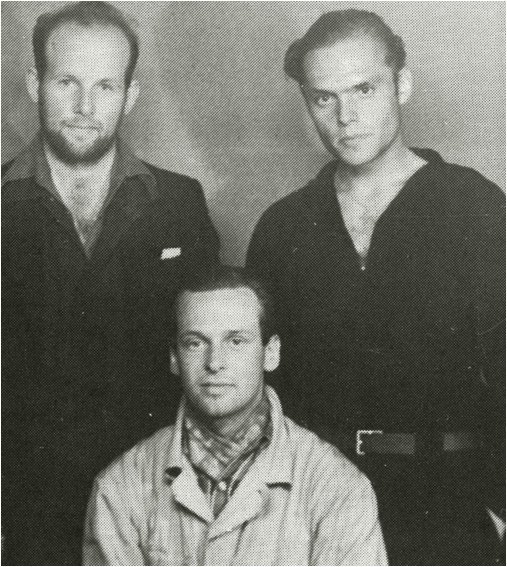
As this document was used to train secret agents, its authors’ names do not appear anywhere in it, but we now know that it was written by two SOE instructors: Paul Dehn (left) and Kim Philby (right). Dehn, a poet and novelist, became a well-known scriptwriter after the war, working on the screenplays of both The Spy Who Came In From The Cold and Goldfinger. Philby went on to rise through the ranks of MI6 and was tipped by many to head it, but was eventually exposed as a double agent working for the Soviets, having been recruited while a student at Cambridge University in the 1930s.

There is a chilling irony in the fact that Kim Philby was one of the writers of the syllabus used to train British secret agents during the Second World War – and one has to wonder as a result how much of it might be propaganda. This is what James Jesus Angleton famously referred to as the ‘wilderness of mirrors’ that populates the world of espionage. Even when being taught about propaganda, you might be subject to it.

In October 1953, a new monthly magazine was launched in Britain: Encounter. An Anglo-American publication, it was a literary magazine that also discussed politics: it was liberal but anti-Communist. Its first editors were Irving Kristol and the poet Stephen Spender, and it was funded by the Paris-based Congress for Cultural Freedom. It became very influential, publishing the work of many of the most famous writers and thinkers of the day, including WH Auden, Vladimir Nabokov, Iris Murdoch and Bertrand Russell. But in 1967, it was revealed that the Congress for Cultural Freedom was a CIA front, and that most of the finance for the magazine had come straight from the CIA’s coffers, with the remainder being provided by the British Foreign Office’s innocuously named Information Research Department – in fact, a secret group dedicated to spreading anti-Communist propaganda. This isn’t a conspiracy theory but widely-documented fact, which the CIA itself acknowledges. Stephen Dorril discusses it at length in his book, MI6: Inside the Covert World of Her Majesty’s Secret Intelligence Service.

The idea for the magazine grew from meetings between MI6 and the CIA, who were looking for a way to influence the thinking of Britain’s liberal and left-wing intelligentsia. Steering the Congress for Cultural Freedom was CIA officer Michael Josselson, a former member of the Psychological Warfare Division. On the British side, the two leaders of the project were initially Tosco Fyvel, a member of the IRD who had been a close friend of George Orwell, and Malcolm Muggeridge, a senior journalist at The Daily Telegraph who also worked for MI6 ‘part time’. Muggeridge eventually grew disillusioned with the behind-the-scenes machinations and withdrew from the project. He was replaced by Goronwy Rees, another MI6 agent. But, to make matters a little trickier, we now know that before the war Rees had passed information to the Soviets, who had given him the codenames FLEET and GROSS.

Encounter’s readers could not, of course, be allowed to suspect that anything they read in the magazine might be propaganda. The merest hint of such a thought would mean the propaganda was ineffective. As a result, the CIA and MI6 left the majority of the magazine’s content alone. That way, it established itself and was soon taken by the intelligentsia in Britain as a genuine and unadulterated liberal voice. Articles that criticized censorship of the arts and other forms of repression behind the Iron Curtain were quietly encouraged, and articles that criticized American foreign or domestic policy were quietly discouraged. Stephen Dorril also reveals in his book the practice of MI6 agents writing articles in the press under pseudonyms, and discusses several such articles published by The Spectator in 1994.

As a result of this hornet's nest, figuring out today which of Encounter’s articles were written with no agenda and which were placed to plant ideas in readers’ minds is a difficult task. Similarly, some articles might have been written by authors who had no idea of the magazine’s real backers, but were published either because they coincidentally transmitted a desirable message, or because they served as good cover for other propaganda to be slipped between.

A good example of this can be found in the issue of May 1966, which I mentioned in my last blog post. The issue contains articles by, among others, Anthony Burgess, Eugène Ionesco, Robert Graves, Frank Kermode (by then an editor of the magazine), Tom Driberg, Malcolm Muggeridge and John le Carré. An extremely impressive line-up of contributors. Any of these articles might have been used by the CIA and MI6 for their own purposes, with the authors’ knowledge. Any may have been used by the CIA and MI6 without the authors’ knowledge. And any may have been used against the CIA and MI6, without their knowledge.

An example of the latter could be Tom Driberg’s article. Driberg was a prominent journalist, Labour MP and, later, Baron Bradwell. He was also gay, and on visiting Moscow in 1956 to interview the British double agent Guy Burgess, he regularly frequented a lavatory behind the Metropole Hotel to pick up men. The KGB showed him ‘compromising material’ of his visits there, and he was recruited as an agent as a result, and given the codename LEPAGE. One of his first acts was the publication of a book claiming that Burgess had never spied for the Soviet Union.

But Driberg broke off contact with the KGB in 1968, and his very dull 1966 article about Edith Sitwell is not a piece of propaganda for either side in the Cold War. Still, it is intriguing that a Soviet agent was writing articles in an MI6/CIA-fronted magazine. Especially considering Rees' involvement – one has to wonder whether the KGB tried to insert its own propaganda into the enemy's propaganda machine.

The article by John le Carré is also worth a closer look, but for very different reasons. Le Carré had worked for both MI5 and MI6, and knew Muggeridge, who had interviewed him just three months earlier for the BBC, as discussed in my last post. But in 1966 le Carré was firmly against American foreign policy, and it is hard to imagine a writer less likely to choose to work for the CIA. Even unknowingly, his article goes against what both MI6 and the CIA would have liked the magazine’s readers to think, because although he attacks many of the problems in the Soviet Union, he concludes that ‘there is no victory and no virtue in the Cold War, only a condition of human illness and a political misery’.

But I think John le Carré was unknowingly used in a different way: his article was one of the many hundreds of genuine ones published in Encounter that provided a suitable context in which MI6 and the CIA could insert a few articles that would make the points they wanted to make, and be taken seriously as a result of the background provided by others. I think one of these articles appears in this issue.

Titled ‘Africa Without Tears’, it was written by Rita Hinden, a socialist South African academic at the University of London, in reaction to news of a series of political murders that had taken place in Nigeria – murders that turned out to be the firing shots in what would become a lengthy civil war. I don’t know whether Hinden wrote the article on the behest of the CIA or MI6, but I think it may have suited their aims, as in it she essentially argued why everyone should turn a blind eye to the worsening political situation in Nigeria and, in effect, let the Africans get on with killing each other.

Hinden made this argument in a way that appears extremely heartless with the knowledge of the deaths that resulted in the civil war, but even without hindsight it is an example of the sort of bizarre double-think some intellectuals engaged in at the time. She develops her thesis over several thousand words, but I think a sense of what she was doing can be seen in the callousness of the title, and in the article’s final paragraph:
‘As long as we continue to regard Africans as a “special case” to be courted, flattered, excused, expected-greater-things-from, grieved-over, explained-away, we will still not have recognized that they have, once and for all, severed the navel cord which used to bind us. And Africans will continue to regard us with the irritation – merging eventually into pity – which marks the attitude of grown-up children to their anxious, ridiculous parents.’
I have read this article many times, because my first novel was set in the Nigerian civil war. The article shocks me every time I read it. As well as being a contributor to Encounter, Hinden was the editor of a magazine called Socialist Commentary, which reflected the views of the pro-American right-wing of the Labour party at the time, and was also involved in the Fabian Society’s journal, Venture, which was funded by the Congress for Cultural Freedom. Michael Josselson described her as a ‘good friend of ours’ and said that the CIA relied heavily on her advice for their African operations.

This article of hers may not have been CIA propaganda, but it was nevertheless CIA-funded, and I think it was propaganda. Its aim was to plant the idea that post-colonial guilt is the real crime for which the article’s readers should feel guilty. It constitutes a ‘guilt complex’, and that ‘emotionalism’ is preventing people from seeing Africa in its proper perspective. Hinden suggested that anyone who felt that Britain had a responsibility to its former colonies was being condescending toward Africans – perhaps even racist. But her claim to respecting Africans was insincere, simply a pretence that offered readers a convenient excuse for ignoring a growing crisis in a country that, in 1966, had been independent just six years, following 160 years of British rule. It’s not callous to be indifferent to the situation in Nigeria, she argued: it’s treating them as the adults they want to be. The article plants some very unpleasant ideas, which were doubtless digested and repeated in conversations across England in various forms in May 1966 and after.

The British government did become involved in the war in Nigeria, but mainly as a supplier of arms to the side they thought had the greater chance of winning and continuing to supply them with oil. Many people in Britain didn’t feel the way Rita Hinden did, and were deeply shocked and moved by the events that took place in Nigeria and Biafra, and many did something about it. Many in Nigeria and Biafra were irritated by Western involvement, but many others were not, as their lives were saved by organizations such as the International Red Cross, Caritas and others.

In his BBC interview with John le Carré, Malcolm Muggeridge revealed with a mischievous glint in his eye that he had once been involved in intelligence. In fact, he still was. John le Carré didn’t reveal that he had also been an intelligence operative, and he did not know that he was about to be used by MI6 in a very elaborate propaganda operation. The part he played in the operation was a very small one: an article about James Bond, which expanded on some of the thoughts he had already expressed in his interview with Muggeridge. The article acted as a lure: it was featured on the cover of the magazine, and le Carré’s name would have attracted readers. But it also acted as cover, because readers of his article may also have read Rita Hinden’s, and been influenced by it. In his article, le Carré wrote of his own novel, The Spy Who Came In From The Cold:
‘I tried to touch new ground when I discussed the phenomenon of committed men who are committed to nothing but one another and the dreams they collectively evoke. At heart, I said, professional combatants of the Cold War have no ideological involvement. Half the time they are fighting the enemy, a good deal of the time they are fighting rival departments. The source of their energy lies not in the war of ideas but in their own desolate mentalities; they are the tragic ghosts, the unfallen dead of the last war.’
There were, doubtless, many professional combatants during the Cold War who acted in just this way. But the irony is that, unknown to John le Carré, his own words were being used by men who did have an ideological involvement, and who were channeling their energies into the war of ideas.

Wednesday, April 21, 2010

Dutch Courage

While writing my third novel, I stumbled on a small problem. I had plotted out a chapter set during the Second World War in which my protagonist, British agent Paul Dark, is sent on a mission to an island in the Baltic. But as I came to write it, I realized I was unsure how he would reach the island. Parachute? Submarine? I reached for one of my most thumbed books, M.R.D. Foot's official history of the Special Operations Executive, to refresh my memory on how that organization had inserted secret agents behind enemy lines during the war. To my great surprise, I found myself reading a passage I had never paid due attention before, mentioning an operation MI6 had undertaken in 1941.

Those few lines took me on a fascinating journey into the origins of one of the best known moments in modern cinema, and taught me a great deal about how fiction and reality can sometimes collide in the most surprising ways. I submitted an article about my research to The Sunday Telegraph, who felt that the story would be better told for their readership if they cut it a little and reframed it as an interview with me. I agreed, and you can read the result here. Below is a slightly extended version of the article I originally submitted to them – click on the images to enlarge them. And Paul Dark's arrival in the Baltic? You'll have to wait a bit for that one. But no dinner jackets are involved.


Dutch Courage
           
Jeremy Duns explores how a real MI6 operation during the Second World War may have inspired one of James Bond’s most famous moments

It’s one of the most iconic – and coolest – scenes in modern cinema. A secret agent emerges from water at night wearing a wetsuit, creeps onto a heavily guarded wharf, knocks out a sentry, and plants some plastic explosive in a storage tank. He then unzips his wetsuit to reveal that he is wearing a dinner jacket beneath it, complete with a carnation in the buttonhole. He walks into the nearest bar, glances at his watch and lights a cigarette just as the storage tank erupts into flames behind him.

This, of course, is the opening scene of the third James Bond film, Goldfinger. Released in 1964, it turned Bond into a global phenomenon, and 007 peeling away his wetsuit to reveal black tie has become one of the most recognisable moments of the series. No such scene featured in Ian Fleming’s novel of the same title, but in many ways it defines the character of James Bond: one moment a tough secret agent focused on a dangerous mission, the next a high-living playboy. It is pure fantasy, of course, and light years away from the world of real espionage.

Or perhaps not. Surprisingly enough, it seems that the scene may have been inspired by an extraordinary mission undertaken by British intelligence during World War Two.

The operation was planned in the autumn of 1941, in a small flat above 77 Chester Square, the London residence of the exiled Dutch queen, Wilhelmina. Three young Dutchmen – Bob van der Stok, Peter Tazelaar and Erik Hazelhoff Roelfzema – had an idea for a method of inserting an agent into occupied Holland, from which they had recently escaped.


As students, the Dutchmen had often spent time at the seaside resort of Scheveningen, near The Hague. They knew that the Palace Hotel there had been taken over by the Germans as a headquarters for their coastal defence forces, and that every Friday night they held a large and boisterous party there. Their idea was both ingenious and audacious – approach Scheveningen in darkness by boat, and then take Peter Tazelaar into the surf by dinghy. He would strip off his watertight suit into evening clothes and make his way ashore, right under the noses of the Germans. If stopped by sentries, he would drunkenly claim to be one of the party-goers. From there, he would continue his mission.

Dutch intelligence in London was mired in political intriguing, and not interested in running the operation – but the British were. They were initially sceptical of the method of inserting Tazelaar onto the beach, which sounded more like a student prank than a serious proposal for an espionage operation, but the head of MI6’s Dutch section, Colonel Euan Rabagliati (right) – nicknamed ‘The Rabbi’ by the Dutch – eventually agreed to the plan.

The mission’s aims were twofold: first, Tazelaar (pictured left, as a naval cadet) was to make contact with a Dutch wireless operator at a safe house and begin transmissions with London at pre-arranged times; secondly, he was to set up a wider intelligence-gathering network to provide reports, maps, photographs and other items that couldn't be transmitted over the wireless but that would be picked up by sea and taken back to London by Motor Gun Boat (ie the same way he had come). In the latter category were also two people, Dr Wiardi Beckman and a Captain Tielens, both of whom Queen Wilhelmina wanted to join the Dutch government-in-exile in London.

To prepare for the operation, The Rabbi sent Hazelhoff Roelfzema and Tazelaar to train at various secret establishments. They learned to shoot at a pistol range beneath Baker Street Underground station and practised boat landings off the coasts of Cornwall and Devon. An experimental watertight suit was made for Tazelaar and, so that his contacts would be in no doubt of his credentials, Queen Wilhelmina was persuaded to write a note in her own hand verifying his mission. MI6 reduced her message to the size of a fingernail, and it was placed inside the collar of Tazelaar’s dress shirt.

The operation itself proved harder to pull off than anticipated, due to poor weather and the difficulties of locating Scheveningen’s promenade in the dark. But after several frustrating false starts, at just after half past four in the morning on November 23 1941, Hazelhoff Roelfzema, Tazelaar and another Dutchman, Chris Krediet, along with Lieutenant Bob Goodfellow, disembarked from British Royal Navy Motor Gun Boat 321 onto a small dinghy. The Dutchmen slipped out of the dinghy as they neared the surf, and Hazelhoff Roelfzema and Tazelaar waded onto Scheveningen’s beach. Hazelhoff Roelfzema helped Tazelaar unzip his watertight suit: beneath it he was wearing immaculate evening clothes. Hazelhoff Roelfzema poured a generous dose of Hennessy XO (Tazelaar’s favourite) from a hip flask over his friend, and returned to the dinghy.

Now reeking of brandy, Tazelaar proceeded to stagger convincingly past the sentries stationed around the hotel. Against all odds, the first part of his operation had succeeded. He made contact with the wireless operator, and within three days had also made contact with Dr Beckman and Captain Tielens. Then things started to go wrong. Tielens didn’t want to make the journey to London, and couldn't be persuaded, but Beckman agreed to the plan. However, the return rendez-vous was beset by problems: the Motor Gun Boat didn't navigate to the meeting point on time, and then a collaborator betrayed the fact that landings were taking place at the beach to the Germans.

On January 18 1942, Hazelhoff Roelfzema (right) arrived on the beach at a prearranged time to deliver two vitally needed transmitters to Tazelaar. But his friend was not there. Thinking quickly, he decided to bury the transmitters in the sand, to be picked up later. But how to let Tazelaar know where to find them? He knew from his student days that there was a telephone booth near the hotel. If he could reach a member of the Resistance, they could tell Tazelaar where the transmitters were buried.

After donning a British naval uniform from the motor gunboat, which he hoped in the darkness would resemble a German one closely enough, Hazelhoff Roelfzema embarked on his own Bond-like mission. Once ashore, he safely passed several sentries and managed to reach the telephone, where he discovered to his horror that it no longer accepted the old Dutch coins he had brought with him. Frustrated, he beat a hasty retreat to the motor gunboat, and headed back to England.

Unknown to him, Tazelaar had had a very good reason for not making the rendez-vous – he and a member of the Resistance had been picked up by the Germans while walking down to the meeting point. Amazingly, they managed to bluff their way out of it: both were wearing dinner clothes, and stuck to the cover story of being drunken revellers. Tazelaar had even brought along a bottle of genever, which he generously passed around. A local policeman, luckily also a member of the Resistance, vouched for the pair, and the Germans let them go. Dr Beckman was not as lucky: he was arrested on the beach waiting to be picked up by motor gunboat, and later died in Dachau.

The highly unusual idea of an agent coming onto an enemy coastline in a watertight suit, only to strip it off to reveal full evening dress and then mingle with the local nightlife festivities, is remarkably similar in concept to the opening sequence of Goldfinger. The director of Goldfinger, Guy Hamilton, was an officer in the Royal Navy’s 15th Motor Gunboat Flotilla during the war, and was involved in landing MI6 agents onto coastlines in much the same way as was done with Peter Tazelaar. But, now 87 and living in Mallorca, Hamilton says he has never heard of the operation in Holland. ‘I was indeed inserting agents into enemy territory from motor gunboats during the war, but they were always as farmers or something along those lines, to blend in with the locals – never in black tie!’

So how did the idea behind this remarkable wartime operation make it into Goldfinger? It was not public knowledge when the film was made, but it was something of a cause célèbre in British intelligence circles. According to the official history of the Special Operations Executive (SOE), published in 1984, MI6 pulled off this operation ‘in a style SOE envied’. The scene in Goldfinger was written by a former SOE agent, Paul Dehn, who had been brought in to polish the first draft of the screenplay by Richard Maibaum. Maibaum’s draft opened with James Bond in black tie watching a dancer stamp her heels in a waterfront nightclub, when a warehouse bursts into flames off-screen. Everyone scatters in turmoil, but 007 stays seated calmly, until Sierra, ‘a well-dressed and good-looking young Latin’ enters the club and approaches Bond. ‘Forgive me for being late,’ he says. ‘There were last-minute complications.’

Dehn evidently decided it would be more exciting if we saw how the operation to blow up the warehouse had been done – and if Bond were the one doing it. The scene first appears in his draft of December 23 1963, albeit in a somewhat less playful form than the version filmed: the ‘hairless distended cadaver of a dead dog, legs pointing stiffly skyward’ drifts through water ‘scummed with flotsam, refuse and vegetable rind’. The dead dog then rises clear of the water, revealing James Bond with his teeth ‘clamped to the cadaver’s underbelly’.

This was deemed too grotesque, and the dead dog became a seagull in the film. But the scene is otherwise almost identical to the finished product. Bond comes ashore in ‘a black water proof suit, zip-pocketed all over and a water proof ruck-sack’, dispatches a couple of sentries, breaks into a storage tank, squeezes gelignite ‘like toothpaste from a stocking’, then clears the wall and reaches comparative safety. Then, ‘in one smart gesture’, he unzips the top of his water-proof suit, revealing a white dinner jacket, ‘complete with red carnation.’

Paul Dehn knew quite a lot about the use of gelignite, attacking storage tanks, and inserting secret agents into enemy territory. In fact, he was an expert. During the war, he had been a senior instructor at SOE’s training school in Beaulieu, and wrote a manual for the organization’s agents. Between 1943 and 1944, he was a senior instructor at Camp X, the centre in Canada set up to train SOE and OSS agents to be inserted behind enemy lines to conduct sabotage operations (he is second from left, below).


Dehn also took part in SOE operations himself, in both France and Norway. Camp X’s syllabus, much of which Dehn probably wrote, and with all of which he would have been very familiar, contained detailed instructions on how to kill sentries silently, place explosives in storage tanks and camouflage oneself when crossing water.


Peter Tazelaar undertook his mission in November 1941 with MI6, but he joined SOE later in the war. Following his brief capture by the Germans in January 1942, his use as an agent in Scheveningen was over. After escaping via Switzerland and Spain, he made his way back to Britain in April 1942, whereupon he was promptly dismissed from the Dutch navy for insubordination, a victim of political intrigues beyond his control. After a stint with the Commandos, Tazelaar also became a training instructor in Canada, at the Dutch military base in Guelph, following which he was recruited by SOE and parachuted back into Holland in 1944, from where he maintained radio contact with London for six months.

There is no evidence that Dehn ever met Tazelaar, either in England or Canada, but it seems likely he would have heard about such a remarkable operation from colleagues either during or after the war. One possible occasion came the year before he started work on Goldfinger. In December 1962, former SOE agent William Deakin organized a conference on wartime resistance in Europe at St Antony’s College, Oxford, of which he was warden. One of the lectures was by Dr Louis de Jong, the director of Holland’s State Institute for War Documentation, and in it he described Tazelaar’s ‘evening dress’ operation in detail. De Jong’s lecture was published in the proceedings of the conference in a limited mimeograph of fewer than 100 copies. Dehn may well have attended the conference or read de Jong’s lecture in the proceedings afterwards.

At any rate, the idea of the real operation seems too bizarre to have been thought up twice, so it seems likely that, one way or another, Paul Dehn learned of it through his contacts in Britain’s close-knit intelligence community and decided it was just the sort of daring mission suitable for James Bond. In drawing on real espionage history and expertise, Dehn created a sensational opening sequence that would become an iconic cinematic moment, but perhaps also paid secret tribute to the ingenuity and bravery of Allied secret agents he had worked with and heard about during the war. If so, that would have been very much in the spirit of Ian Fleming, who did much the same in his novels.

Dehn went on to work on the screenplays for The Spy Who Came in from the Cold, The Deadly Affair and several other films. He died in 1976.

Erik Hazelhoff Roelfzema continued to run operations on the coast of Holland, inserting agents, weapons and transmitters, before joining the Royal Air Force – he flew 72 missions in a Mosquito and was awarded the Distinguished Flying Cross, as well as the Militaire Willemsorde, the Netherlands’ highest military decoration. After the war, he emigrated to the United States. His autobiography, Soldaat van Oranje (Soldier of Orange), was published in 1971 and was made into a film by Paul Verhoeven in 1977, with Rutger Hauer starring as a fictionalised version of him and Jeroen Krabbé as a composite of several characters, including Peter Tazelaar. Edward Fox played a version of Euan ‘The Rabbi’ Rabagliati.

Soldier of Orange was the most expensive Dutch film made to date, and helped pave the way for Verhoeven and Hauer’s careers in Hollywood. It was also a calling card for Krabbé. In the DVD documentary Inside The Living Daylights, the James Bond films' producer and writer Michael G Wilson mentions that Krabbé, who plays Koskov in The Living Daylights, had been brought to their attention by Soldier of Orange.

In 2003, Hazelhoff Roelfzema published In Pursuit Of Life, an expanded autobiography in English, including most of the material from Soldier of Orange. The introduction was by Len Deighton. Hazelhoff Roelfzema died in Hawaii in 2007.

Bob van der Stok also joined the RAF, but his Spitfire was shot down in France in 1942 and he was captured by the Germans. He was imprisoned in Stalag Luft III, but was one of the three men to tunnel his way out. In the film The Great Escape, James Coburn’s character was partly based on van der Stok. He died in 1993.

Peter Tazelaar’s life could have provided enough material for several films. Queen Wilhelmina also awarded him the Militaire Willemsorde, and in May 1945 he and Hazelhoff Roelfzema became her aides de camp. Tazelaar wasn’t satisfied with that, though, and went off to Ceylon (now Sri Lanka) to fight the Japanese. After that, he served with the military police during the Dutch colonial war in Indonesia, then became a CIA agent, carrying out several missions in eastern and central Europe during the 1950s. He died in 1993.

‘He had a lot in common with James Bond,’ says Victor Laurentius, author of a recently published biography, De Grote Tazelaar: Ridder & Rebel (‘The Great Tazelaar: Knight and Rebel’). ‘He was good looking, a cool womanizer, and in many ways an atypical spy.’ Laurentius points out that, like Bond, Tazelaar was an inveterate daredevil: during his operations, he spent significant amounts of time in casinos and other places crowded by German officers.

Real espionage is, of course, much less glamorous than a Bond film, even if you’re in black tie. Peter Tazelaar was one of the lucky ones: many Dutch agents ended up captured, tortured and shot. Nevertheless, his remarkable brandy-soaked stroll past the sentries at Scheveningen stands as one of the most imaginative and daring espionage operations of the Second World War. Next time you watch Goldfinger, spare a thought for the real spy who dared to journey behind enemy lines in a dinner jacket.

With many thanks to Guy Hamilton; Victor Laurentius; Lynn Hodgson, Renu Barrett at McMaster University Library, Ontario; Sophie Bridges at the Churchill Archives Centre, Cambridge; and Colleen Kelley at the Special Collections of the University of Iowa Libraries.


SELECT BIBLIOGRAPHY

EH Cookridge, Set Europe Ablaze: Special Operations Executive in Western Europe 1940-1945 (Pan, 1969)
MRD Foot, SOE: The Special Operations Executive, 1940-1946 (BBC, 1984)
Erik Hazelhoff Roelfzema, Soldier of Orange (Sphere, 1982)
Erik Hazelhoff, In Pursuit Of Life (Sutton, 2003)
Louis de Jong, Britain and Dutch Resistance, 1940-1945 (delivered at a conference on Britain and European resistance, St Anthony’s College, Oxford, December 10-16, 1962)
Victor Laurentius, De Grote Tazelaar, Ridder & Rebel (Stichting Peter Tazelaar, 2010)
Denis Rigden (introduction), SOE Syllabus: Lessons in Ungentlemanly Warfare, World War II (PRO, 2004)
Adrian Turner, On Goldfinger (Bloomsbury, 1998)

On the web:
http://www.petertazelaar.nl/
http://www.erikhazelhoff.com/