In his review of From Russia With Love in April 1964, Australian critic Colin Bennett wrote of the film’s opening sequence:
‘Our James makes his pre-credit appearance this time in the dark of a Marienbad garden, where he is neatly strangled by a blond Russian killer. (The gimmick used to keep him alive could only have been more effective if it had not also been used in Adrian Messenger.)’1
Alain Resnais’ Last Year At Marienbad, released in 1961, explored the nature of memory and dreams against the backdrop of an elegant château and its grounds.

John Huston’s The List of Adrian Messenger, released in 1963, featured George C Scott as a retired MI5 agent investigating a series of apparently accidental deaths; several famous actors, including Kirk Douglas and Burt Lancaster, appeared heavily disguised by make-up, which they removed at the end of the film to reveal themselves. The opening scene of From Russia With Love concludes with the revelation that the dead James Bond is in fact another man wearing a mask, and we realize we have witnessed a gruesome murder by an organization training to kill 007.
Bennett was right on at least one of his observations. In 1991, the director of From Russia With Love, Terence Young, discussed the film’s opening scene:
‘This was entirely stolen. I’d just seen a very pretentious picture called L’année dernière à Marienbad, where everybody was wandering down moonlight paths with sculptures and Christ knows what, so we put Sean in there…’2
Despite feeling Resnais’ film was pretentious, Young was nevertheless influenced by it. As well as drawing us into an opulent and elegant world, the opening scene of From Russia With Love is also, like Last Year At Marienbad, puzzling, eerie and dream-like. Dreams often consist of compelling and vivid episodes: we’ve all woken feeling as though we have just experienced some amazingly intricate adventure in which we were pursued by unseen forces, one person suddenly became another, and so on. The opening of From Russia With Love has something of that feeling and, as with a dream, it’s only after it’s over that we realize it didn’t make any sense. If an organization wanted to train to kill James Bond, they probably wouldn’t go to the trouble and expense of creating incredibly lifelike masks to put on sacrifical human targets. And why stalk someone who looks like Bond through the gardens of a country house when, judging from the rest of the film, they have no intention of trying to trap Bond in such a place? But even if we recognize these logical flaws, they don’t overly bother us. This is clearly not the sort of training exercise any organization would undertake in real life, but it’s not meant to be a realistic portrayal of espionage. It’s a fantasy, and it uses dream logic – or film logic.
The opening of From Russia With Love helped establish the often fantastic atmosphere of the Bond films, and proved influential in its own right – Mission: Impossible, which made its debut on US TV two years later, frequently featured lifelike masks being peeled off by secret agents, in a kind of repeated variation of the shock that comes at the end of this scene.
Another film some critics felt was influenced by Last Year At Marienbad was Inception, released earlier this year. In an interview with The New York Times, director Christopher Nolan discussed this perception:
‘Everyone was accusing me of ripping it off, but I actually never got around to seeing it. Funnily enough, I saw it and I’m like, Oh, wow. There are bits of “Inception” that people are going to think I ripped that straight out of “Last Year at Marienbad.”
Q. What do you think that means?
A. Basically, what it means is, I’m ripping off the movies that ripped off “Last Year at Marienbad,” without having seen the original. It’s that much a source of ideas, really, about the relationships between dream and memory and so forth, which is very much what “Inception” deals with.’ 3
Several other critics felt that Inception was heavily inspired by the James Bond films. Nolan confirmed this to Empire:
‘This is absolutely my Bond movie… I’ve been plundering ruthlessly from the Bond movies in everything I’ve done, forever. I grew up just loving them and they’re a huge influence on me. When you look at being able to construct a scenario that’s only bound by your imagination, I think the world of the Bond movies is a natural place your mind would go.’4
In particular, he confirmed the influence of the 1969 film On Her Majesty’s Secret Service:
‘I think that would be my favorite Bond. It’s a hell of a movie, it holds up very well. What I liked about it that we’ve tried to emulate in this film is there’s a tremendous balance in that movie of action and scale and romanticism and tragedy and emotion. Of all the Bond films, it’s by far the most emotional. There’s a love story. And Inception is a kind of love story as well as anything else...’4
Influence, then, can be hard to pin down and at several removes, or it can be hard to miss. Colin Bennett was right that From Russia From With Love was directly influenced by Last Year At Marienbad – Terence Young confirmed it. We don’t know whether or not The List of Adrian Messenger was also an influence. Critics who felt Inception was directly influenced by Last Year At Marienbad were wrong, but those who felt there were references to On Her Majesty’s Secret Service were right. In the latter case, the similarities are not just thematic, but precise. As in the finale of On Her Majesty’s Secret Service, the characters in Inception storm a clinic that is more like a fortress, positioned on a snowy mountainside. The accompanying music, costumes and other details all make the connection explicit.


An even clearer example of influence occurs later in From Russia With Love, in the scene in which James Bond is chased across a barren stretch of country by a low-flying helicopter. He tries to head for shelter, but as the helicopter passes over him he flattens himself on the ground. Terence Young also confirmed that this was a ‘steal’ from the famous crop-dusting scene in North By Northwest 2, but we hardly need proof: common sense tells us it must be.

The situation is a little similar with Ian Fleming’s novels. In some cases, we know what Fleming’s influences were because he remarked on them. In others, we can guess he was inspired by other works, but have no confirmation of it. Our guess may be a very plausible one, but still be incorrect. But sometimes the level of correspondence is so high that proof is not needed, and common sense will do.
But why focus on influence at all? Does it make any difference who was inspired by whom? Not always, no. We can just sit back and enjoy the story. If it works, who cares what inspired it? But if we want to examine Ian Fleming’s place in the literary canon, yes, his influences matter.
There are also degrees of influence. The scene with the helicopter chasing Bond in From Russia With Love is a direct reference to North By Northwest. The opening scene, on the other hand, is relatively lightly influenced by Last Year At Marienbad. Influence can be more general still. Inception features a scene in which the protagonist, Cobb, is being chased through the streets of Mombasa by men shooting at him. He finds a side street and runs down it. He slams against a wall and realizes it is part of a narrower alleyway, which he heads down. It narrows further, becoming impossibly tight, the walls seeming to close in on him. He pushes against them desperately as the men behind him gain ground, finally managing to squeeze his way through.
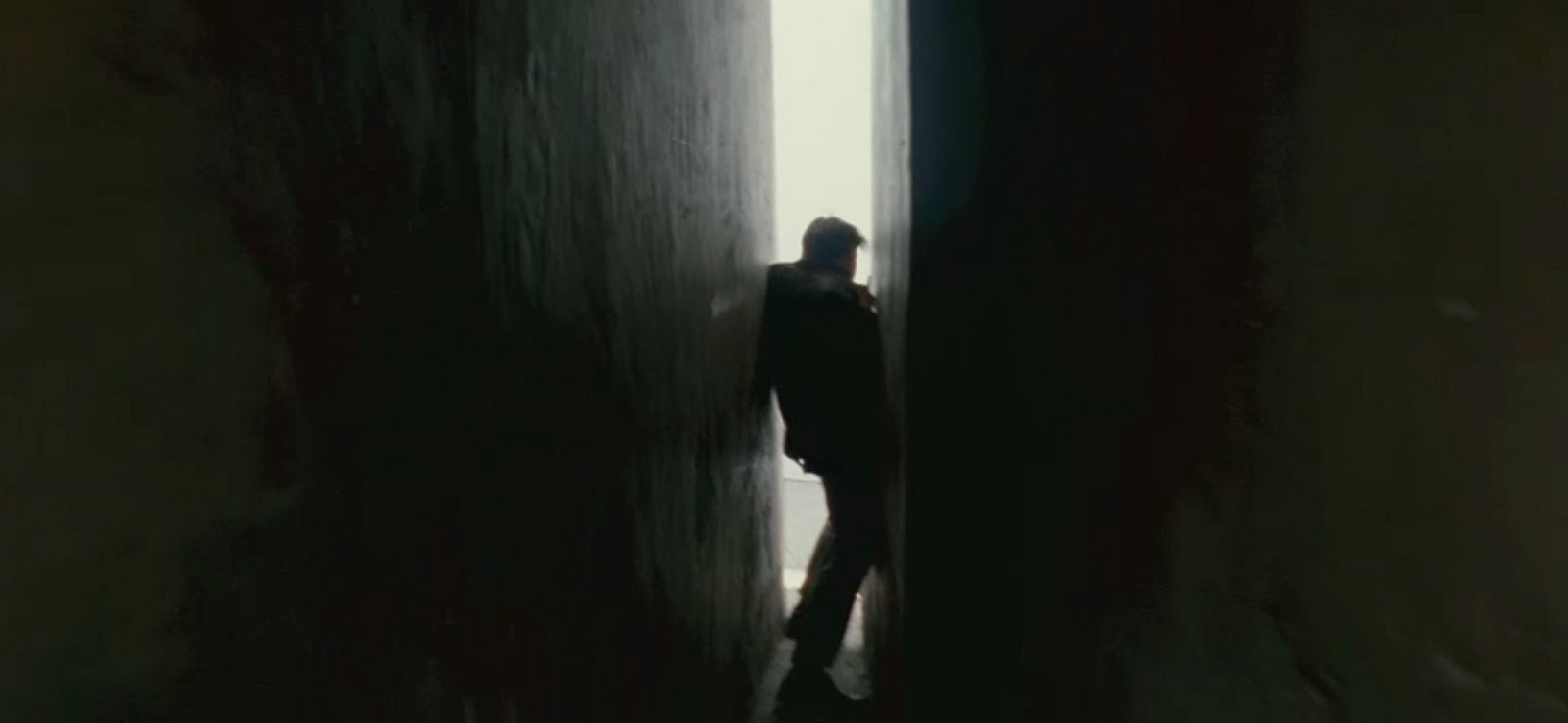
I don’t think this is inspired by anything in particular. It’s simply a convention that is often seen in thrillers, and I doubt anyone knows who originated it. In my last post, Bloods Line, I discussed Sexton Blake, and this convention can be seen in the 1968 comic strip Sexton Blake and The Museum of Fear.

But it’s been used countless times. And as well as being a thriller convention, it is also, of couse, a classic anxiety dream moment, which is no doubt why Nolan used it. Thrillers often echo dreams: many a synopsis proclaims that the protagonist is ‘plunged into a nightmare’. In a 1965 interview for French television, Alfred Hitchcock described North By Northwest as a nightmare that seems real:
‘Everything seems real in a dream: you are glad to wake up because it’s so real. So you take a dream idea like [North by Northwest]. It’s a nightmare… and you make it real. The audience are looking at a nightmare, and crazy things are happening. But it must be real.’5
Inception features dreams that echo films – the scenes inspired by On Her Majesty’s Secret Service – but I think the narrowing alleyway scene in Mombasa is a feedback loop: a dream sequence reminiscent of thrillers reminiscent of dreams… Where you start the loop can change your interpretation of the film. Great thrillers don’t simply recycle conventions in a mechanistic working through of plot: they use them to tap into deeper concerns and emotions. I think one purpose of this scene may be to suggest (or perhaps implant) the idea that, just as cinematic and fictional conventions often echo our dreams, perhaps our dreams are also affected by fictional archetypes.
Influence can flow in unexpected directions, which make it harder to untangle. Sexton Blake and other characters in the penny dreadfuls led to the likes of Dan Dare – the success of which probably influenced the ongoing Sexton Blake series. The same can be said of James Bond. Once Bond became successful, several characters that predated Fleming’s novels – including Sexton Blake – were either repackaged or completely updated to jump on the bandwagon. This can be seen with Jean Bruce’s OSS 117, Leslie Charteris’ The Saint, Sapper’s Bulldog Drummond and many others. Roger Moore played The Saint before he played James Bond; coupled with that TV series’ increased aping of the Bond films, the impression is that Simon Templar is a character imitative of James Bond, when the reverse may be true.


Influence is not always cut and dried, and can be difficult to trace, but that doesn’t mean it should be ignored. Exploring it sensibly can open up our perceptions of what individual works have to say, and how fiction works in broader terms. All of which brings me to White Eagles Over Serbia.

‘In the armoury at Millbank he presented his service order and was allowed to play about with pistols of every calibre and shape. Henslowe, the artificer, followed him about benevolently, showing him his wares with absurd pride. “You never turned in that Luger you borrowed, Colonel Methuen,” he said reproachfully. “I have to answer for it to the War Office.”
Methuen apologized. “It’s lying in a swamp somewhere,” he explained, and was immediately given an elaborate form to fill up with a description of how the weapon had been lost. “Just put L on D (lost on duty),” said Henslowe sorrowfully. “Now you say you want one with a silencer.”
“Small,” said Methuen. “Pocketable.”
“There’s a new point three eight,” said Henslowe regretfully, but with the air of a haberdasher finding the right size of neck and wrist for a man of unusual shape. “Only for heaven’s sake bring it back! You see,” he added, “it’s still on the experimental list. First time they’ve fitted a silencer of this pattern to a point three eight. It’s a sweet weapon, werry sweet.” He pronounced the word “weepon”. He found the pistol in question and pressed it upon his visitor, holding it by the barrel. It was small but ugly looking. “The balance is not all it might be, sir. But it’s a werry sweet weapon.”
They tried it downstairs on the miniature range. “It’ll do me very well,” said Methuen. “I must say it hardly makes any noise at all.”
“Just a large sniff, sir. Like a man with a cold.”
“Send it up to me,” said Methuen, and Henslowe inclined his head sorrowfully with the air of a man who is glad to serve but who feels that he is in danger of losing a much-cherished possession. “You won’t leave it in a swamp, will you, sir?” Methuen promised faithfully not to. “It’s hard when we get so few nice things these days.”
“I know.”’6
Dr No, published the following year, features some of the same conventions as White Eagles Over Serbia, such as the secret agent sent overseas to investigate the mysterious death of a colleague. In an early scene, M calls in MI6’s Armourer, Major Boothroyd, to assess Bond’s choice of weapon for his forthcoming mission:
‘M’s voice was casual. “First of all, what do you think of the Beretta, the .25?”
“Ladies’ gun, sir.”
M raised ironic eyebrows at Bond. Bond smiled thinly.
“Really! And why do you say that?”
“No stopping power, sir. But it’s easy to operate. A bit fancy looking too, if you know what I mean, sir. Appeals to the ladies.”
“How would it be with a silencer?”
“Still less stopping power, sir. And I don’t like silencers. They’re heavy and get stuck in your clothing when you’re in a hurry. I wouldn’t recommend anyone to try a combination like that, sir. Not if they were meaning business.”
M said pleasantly to Bond, “Any comment, 007?”
Bond shrugged his shoulders. “I don’t agree. I’ve used the .25 Beretta for fifteen years. Never had a stoppage and I haven’t missed with it yet. Not a bad record for a gun. It just happens that I’m used to it and I can point it straight. I’ve used bigger guns when I’ve had to – the .45 Colt with the long barrel, for instance. But for close-up work and concealment I like the Beretta.” Bond paused. He felt he should give way somewhere. “I’d agree about the silencer, sir. They’re a nuisance. But sometimes you have to use them.”
“We’ve seen what happens when you do,” said M drily. “And as for changing your gun, it’s only a question of practice. You’ll soon get the feel of a new one.” M allowed a trace of sympathy to enter his voice. “Sorry, 007. But I’ve decided. Just stand up a moment. I want the Armourer to get a look at your build.”
Bond stood up and faced the other man. There was no warmth in the two pairs of eyes. Bond’s showed irritation. Major Boothroyd’s were indifferent, clinical. He walked round Bond. He said “Excuse me” and felt Bond’s biceps and forearms. He came back in front of him and said, “Might I see your gun?”
Bond’s hand went slowly into his coat. He handed over the taped Beretta with the sawn barrel. Boothroyd examined the gun and weighed it in his hand. He put it down on the desk. “And your holster?”
Bond took off his coat and slipped off the chamois leather holster and harness. He put his coat on again.
With a glance at the lips of the holster, perhaps to see if they showed traces of snagging, Boothroyd tossed the holster down beside the gun with a motion that sneered. He looked across at M. “I think we can do better than this, sir.” It was the sort of voice Bond’s first expensive tailor had used.’7
Boothroyd recommends Bond use a Walther PPK 7.65 mm. or Smith & Wesson Centennial Airweight Revolver .38, and gives a lot of information about both. In May 1956, gun enthusiast Geoffrey Boothroyd wrote to Fleming suggesting that Bond change weapons from the ladylike Beretta to a Walther PPK. Fleming replied that he appreciated the advice and proposed changing Bond’s weapon in the next book he wrote, adding ‘I think M. should advise him to make a change’.8 He didn’t specify that he would create an armourer character, or name him after Boothroyd, but the idea seems a natural enough way to introduce the change.
But there are still some intriguingly close similarities between these two scenes. Both Henslowe the artificer and Boothroyd the armourer are condescending towards the agent they are fitting out: Henslowe has ‘the air of a haberdasher finding the right size of neck and wrist for a man of unusual shape’, while Boothroyd speaks in ‘the sort of voice Bond’s first expensive tailor had used’. This seems natural now, but upper-class Brits discussing lethal weapons as though they are bespoke clothing items is a convention we usually date to the Bond series, and particularly the films. In some ways, Durrell’s scene is more reminiscent of a Bond film than Fleming’s: Methuen’s nonchalance about having lost his previous weapon while conducting his most recent mission and Henslowe’s anxiety that he might lose the costly experimental weapon he is now giving him would become staples of the scenes between Bond and Q in the films.
But there are still some intriguingly close similarities between these two scenes. Both Henslowe the artificer and Boothroyd the armourer are condescending towards the agent they are fitting out: Henslowe has ‘the air of a haberdasher finding the right size of neck and wrist for a man of unusual shape’, while Boothroyd speaks in ‘the sort of voice Bond’s first expensive tailor had used’. This seems natural now, but upper-class Brits discussing lethal weapons as though they are bespoke clothing items is a convention we usually date to the Bond series, and particularly the films. In some ways, Durrell’s scene is more reminiscent of a Bond film than Fleming’s: Methuen’s nonchalance about having lost his previous weapon while conducting his most recent mission and Henslowe’s anxiety that he might lose the costly experimental weapon he is now giving him would become staples of the scenes between Bond and Q in the films.
Durrell’s reference to ‘Special Operations Q Branch’ may appear to be a reference to Fleming, as ‘Q Branch’ had been mentioned in passing in several earlier Bond novels. But in Durrell’s novel it is not the name of a technical department, as it is in Fleming and would later be in the Bond films, but of an intelligence unit – so more like the Double O Section. After the Second World War, MI6 established a section called Q Branch for the administration of stores and equipment, which was run by ‘an experienced army quartermaster colonel with the designation Q’.9 Fleming might have known this through his own contacts in the organization, as might Durrell, who had worked for British intelligence in Belgrade in the early Fifties.10

But all this is guess-work. As far as I know, Ian Fleming never mentioned Lawrence Durrell’s book as an inspiration in any interviews or correspondence, and the similarities between the scenes, while numerous, are not close enough to be a ‘smoking gun’, with or without experimental silencer. It may simply be coincidence or, perhaps more likely, that Durrell and Fleming were both inspired by similar scenes in earlier thrillers. I’m not aware of any prior to 1957 that involve a weapons expert picking out a pistol for a secret agent’s forthcoming mission, but there are lots of thrillers I haven’t read or seen. Suggestions gratefully received.
Regardless, the scene in White Eagles Over Serbia tells us several things. Most obviously, it tells us that Ian Fleming did not create this particular convention, which we might otherwise have thought he did. Durrell may not have originated it, either, but we know Fleming didn’t. It also shows how influence diverges and takes new shapes. Durrell’s scene was itself a variation of a more general and well-established convention, that of ‘preparing before setting off for an adventure’. Erskine Childers’ The Riddle of the Sands, for example, published in 1903, opens with Foreign Office official Carruthers being contacted by an old acquaintance, Davies, and asked to join him on a sailing trip. Carruthers duly runs around London collecting equipment Davies has specified he bring along. This can be seen in several early British adventure stories involving exploration. Durrell’s and Fleming’s scenes are a more specific version of that convention; a secret agent being assigned a weapon by an expert. Ie, not just a man being shot at, but a man being shot at from above by a low-flying craft while he runs across barren countryside.
White Eagles Over Serbia is a love letter to the British adventure story, but while the plot is reminiscent of John Buchan and Rider Haggard, the romance is occasionally sprinkled with a dry and melancholic tone more akin to Somerset Maugham or Graham Greene. In a general sense, the same could be said of the Bond novels, but both sets of influences are much weaker. Durrell and Fleming were drawing on some of the same influences, but developed a very different mixture.
Finally, these two scenes may be an example of influence turning inward on itself. The armourer Major Boothroyd didn’t appear in any other Fleming novels, but he did appear in a similar scene to this in the film of Dr No. In subsequent films, he was played by Desmond Llewellyn, and became known as Q. Instead of simply being an armourer, he was now head of the Q Branch mentioned but never seen in Fleming’s novels, responsible not just for providing Bond with weaponry, but also a range of ingenious equipment. The convention took on a new form with the films, then, and hundreds of thrillers followed with dotty inventors kitting out spies with outrageous gadgets.
In 1968, Lawrence Durrell published Tunc, which featured Felix Charlock, an inventor who works for the sinister international conglomerate Merlin, sometimes known as ‘The Firm’. Charlock goes on the run; trying to bring him back is Merlin’s shadowy director, Julian, who Charlock has never seen. The sequel, Nunquam, published in 1970, opens with Charlock in a luxurious but anonymous sanatorium-prison in the Swiss Alps. He is released by The Firm and finally meets Julian, for whom he builds a lifelike robot, a perfect replica of a beautiful dead actress with whom Julian is obsessed. The robot also rebels, wreaking havoc and destruction.


Several critics detected similarities between these two novels and the Bond series. Kirkus wrote of Tunc that ‘the plots criss-cross round a gigantic international “firm” called Merlin (somewhat like a spectre in the Bond dream World)’ [sic], referring to S.P.E.C.T.R.E., while France’s Journal de l’année wrote that in Nunquam Durrell wanted to simultaneously evoke James Joyce and James Bond. Reviewing the same novel in The Observer, Benedict Nightingale noted: ‘There are times when one wonders if one isn’t reading some unholy coupling of Swinburne and Ian Fleming’.11
Perhaps these novels were influenced directly by Bond or perhaps, as with Inception and Last Year At Marienbad, by other thrillers that were influenced by Bond. But it may also be that Lawrence Durrell influenced Ian Fleming directly in 1957, only to be influenced by Fleming himself a decade later.
White Eagles Over Serbia is a love letter to the British adventure story, but while the plot is reminiscent of John Buchan and Rider Haggard, the romance is occasionally sprinkled with a dry and melancholic tone more akin to Somerset Maugham or Graham Greene. In a general sense, the same could be said of the Bond novels, but both sets of influences are much weaker. Durrell and Fleming were drawing on some of the same influences, but developed a very different mixture.
Finally, these two scenes may be an example of influence turning inward on itself. The armourer Major Boothroyd didn’t appear in any other Fleming novels, but he did appear in a similar scene to this in the film of Dr No. In subsequent films, he was played by Desmond Llewellyn, and became known as Q. Instead of simply being an armourer, he was now head of the Q Branch mentioned but never seen in Fleming’s novels, responsible not just for providing Bond with weaponry, but also a range of ingenious equipment. The convention took on a new form with the films, then, and hundreds of thrillers followed with dotty inventors kitting out spies with outrageous gadgets.
In 1968, Lawrence Durrell published Tunc, which featured Felix Charlock, an inventor who works for the sinister international conglomerate Merlin, sometimes known as ‘The Firm’. Charlock goes on the run; trying to bring him back is Merlin’s shadowy director, Julian, who Charlock has never seen. The sequel, Nunquam, published in 1970, opens with Charlock in a luxurious but anonymous sanatorium-prison in the Swiss Alps. He is released by The Firm and finally meets Julian, for whom he builds a lifelike robot, a perfect replica of a beautiful dead actress with whom Julian is obsessed. The robot also rebels, wreaking havoc and destruction.


Several critics detected similarities between these two novels and the Bond series. Kirkus wrote of Tunc that ‘the plots criss-cross round a gigantic international “firm” called Merlin (somewhat like a spectre in the Bond dream World)’ [sic], referring to S.P.E.C.T.R.E., while France’s Journal de l’année wrote that in Nunquam Durrell wanted to simultaneously evoke James Joyce and James Bond. Reviewing the same novel in The Observer, Benedict Nightingale noted: ‘There are times when one wonders if one isn’t reading some unholy coupling of Swinburne and Ian Fleming’.11
Perhaps these novels were influenced directly by Bond or perhaps, as with Inception and Last Year At Marienbad, by other thrillers that were influenced by Bond. But it may also be that Lawrence Durrell influenced Ian Fleming directly in 1957, only to be influenced by Fleming himself a decade later.
Notes
1. ‘Thrills and Tricks’ by Colin Bennett, The Age, April 25 1964.
2. From Russia With Love audio commentary, Criterion Collection, Laserdisc, 1991.
3. ‘A Man and His Dream: Christopher Nolan and ‘Inception’’ by Dave Itzkoff, The New York Times, June 30 2010.
4. ‘Crime Of The Century’ by Dan Jolin, Empire, July 2010.
5. Hitchcock s’explique, Cinéma Cinémas, directed by André Labarthe, 1965.
5. Hitchcock s’explique, Cinéma Cinémas, directed by André Labarthe, 1965.
6. pp27-28 White Eagles Over Serbia by Lawrence Durrell, Faber, 1957.
7. pp18-19 Dr No by Ian Fleming, Pan, 1965.
8. Letter from Ian Fleming to Geoffrey Boothroyd, May 31 1956. See ‘Letters to The Armourer’ by ‘SiCo’, Absolutely James Bond, September 12 2004. Available at: http://jamesbond.ajb007.co.uk/lettersupdate
7. pp18-19 Dr No by Ian Fleming, Pan, 1965.
8. Letter from Ian Fleming to Geoffrey Boothroyd, May 31 1956. See ‘Letters to The Armourer’ by ‘SiCo’, Absolutely James Bond, September 12 2004. Available at: http://jamesbond.ajb007.co.uk/lettersupdate
9. pp644-645 MI6: The History of the Secret Intelligence Service 1909-1949 by Keith Jeffery (Bloomsbury, 2010).
10. p81, British intelligence, strategy, and the cold war, 1945-51 by Richard James Aldrich (Routledge, 1992).
11. Kirkus Reviews, March 25 1968; p228, Journal de l’année, Larousse, 1971; ‘Dance of Seven Veils’ by Benedict Nightingale, The Observer, March 22 1970.
This is part of 007 In Depth, a series of articles on Ian Fleming and James Bond.
11. Kirkus Reviews, March 25 1968; p228, Journal de l’année, Larousse, 1971; ‘Dance of Seven Veils’ by Benedict Nightingale, The Observer, March 22 1970.
This is part of 007 In Depth, a series of articles on Ian Fleming and James Bond.


