Showing posts with label Free Country. Show all posts

Thursday, June 9, 2011

Free Country becomes Song Of Treason

Some exciting news. My second Paul Dark novel, Free Country, was published by Simon & Schuster in the UK and Canada last year in hardback and trade paperback. On August 18, the mass-market paperback will be published, and while the book itself is exactly the same, the packaging has had a complete overhaul. Firstly, as you can see below, the artwork has changed. And secondly, the book’s title has changed. It will now be called Song Of Treason.

This is an unusual occurrence in the world of publishing, but it occasionally happens – here’s an article about it. The reason for it in this case is pretty simple: my publisher felt there was a danger that Free Country might not signal to those who hadn’t read the first book in the series, Free Agent, that it was a spy thriller. I agreed, and tried to come up with a new title that would stand out in bookstores and on websites, and let everyone know what sort of novel they’d be in for. I hope this title does that, and I think the new cover they’ve done for it is fantastically atmospheric, and evokes both the tone of the novel and its Italian setting, which includes this very colonnade in Rome’s Piazza San Pietro. My hat is off, once again, to Rafaela Romaya and the rest of the superb S&S art department. Anyway, I love it – but here, see what you think! Click on it to get a larger version.


The book will be published by Penguin in the US next year, although I don’t yet have a date for it – watch this space. It will still be known as Free Country there, and the third book will be titled Free World. In the UK and Canada, Book 3 will be titled The Moscow Option, and it will be out in February 2012 and is already available to pre-order at your nearest online book emporium, with a brief synopsis telling you what to expect. Although the trilogy ends there, Paul Dark does not, as I’ve just signed a new contract with Simon & Schuster and am hard at work on a fourth Dark novel, set in 1971. This continues his story from the first three books, I hope in an unexpected and exciting way.

In the meantime, the BBC are continuing to develop the novels as a TV series, and a screenplay is now being written by Timothy Prager (55 Degrees North, Silent Witness, Waking The Dead). Again, please watch this space. And thank you for your continuing support for the books. I don't know what has happened, but for some reason traffic on this blog has increased dramatically recently, and particularly so today. Please check back regularly for more news, or join my new Facebook group, or follow me babbling nonsense on Twitter. I’ll be running some juicy competitions via both in coming months.


(EDIT: In the event, Penguin US have published all three of the novels in an omnibus edition titled The Dark Chronicles, and within it have used the same titles as the British editions, ie Free Agent, Song of Treason and The Moscow Option.)

Thursday, August 5, 2010

Free Country is published in the UK

Publication day is here once again, with the the release of my second novel, Free Country, by Simon & Schuster in the UK, Canada, Australia and New Zealand. You can buy it from all the usual places, including Amazon, Waterstones, Play.com, Chapters.Indigo, WH Smith and The Book Depository . The 'hotly anticipated and gripping sequel to "retro-cool romp" Free Agent', the book takes Paul Dark to Italy, where he has to uncover a conspiracy that dates back to the earliest days of the Cold War. I hope it's an intense and gripping read that people will enjoy, but will also find thought-provoking, as its subject is rather bleak: terrorism, and the role governments sometimes play in it. You can read more about the book in this top secret dossier that Simon & Schuster have 'leaked' online, and which features highlights from Paul Dark's MI6 dossier, among other things. If you want a hard copy of this document, S&S are giving away a limited number of them. Follow my publicist Anna Robinson's Twitter account for details.

I was interviewed at Harrogate by Unbound, and you can find the transcript of that here, and the full audio of it here. I talk about my inspirations for Paul Dark, the Biafran war, and a little about the screenplay for Ian Fleming's book The Diamond Smugglers, which I discovered a while ago and wrote about for The Sunday Times here. The author of that screenplay, the Australian writer Jon Cleary, sadly died last week, having sold eight million books over seven decades as a writer. I had the honour of talking to him on the telephone, and found him erudite, charming and with a wickedly dry wit. There was an obituary of him in The Australian, and I also highly recommend reading his thrillers, especially those featuring Scobie Malone.

I've also done a short interview at Simplyreaders.co.uk, which you can read here, and I've got another few coming up shortly. Keep an eye on my Facebook and Twitter pages for more info - and I hope you enjoy Free Country! I certainly had a lot of fun writing it.

Friday, July 30, 2010

Back from Harrogate; signed books

Discussing the future of the thriller with, from left, Zoë Sharp, Sean Black, Jo Nesbø and Meg Gardiner (Photograph courtesy Zoë Sharp)
I'm back home in Stockholm after a great week in England, most of which was spent at the Harrogate crime writing festival. I met dozens of readers, writers, editors, agents, and publishers, and drunk a little too much Oban in the hotel bar while doing so. But I learned a lot. On Sunday, I was on a panel with four other writers, discussing the future of the high-octane thriller. It was a little nerve-wracking, as it was my first time speaking in public, but I hope I managed to make a few half-intelligible points. Meg Gardiner was moderating the discussion, and kept us all in check - there were cameras there, so if it goes online at some point I'll provide the link.

I chatted with tons of people, including briefly with RJ Ellory, who I congratulated for winning the Theakstons Old Peculier Crime Novel of the Year with A Simple Act Of Violence. Much to my surprise, he told me he had read Free Agent. I also met Mark Billingham, Simon Kernick, SJ Parris, Joseph Finder, Kevin Wignall, James Twining and fellow Simon & Schuster UK authors Chris Ewan, Craig Robertson and Chris Carter. I bonded over Quiller and Coronas with Jason Elliot, and over Sean Connery and the Bourne films with Tom Hinshelwood and Howard Linskey.

But I think the greatest thing about the festival was getting to meet readers. Thank you very much to everyone who came up to say hello, bought one of my books, or who was subjected to listening to me waxing lyrical about thrillers. And if you did buy one of my novels and enjoy it, please spread the word!

If you couldn't make it to Harrogate but fancy buying a copy of Free Agent or Free Country - the latter will be published in the UK a week today - I signed several copies of both while in England. Warwick Books have a few remaining, and I also signed and numbered 100 hardbacks of Free Country with a 'Top Secret' stamp for Goldsboro Books.

Thursday, May 6, 2010

How I write a thriller

Timothy Hallinan, author of the Poke Rafferty series, has an excellent blog, in which he often looks at the process of writing. A couple of months ago he sent out a request for submissions from novelists on how they planned their books: did they plot rigidly in advance, or did they wing it, or a mix of the two, and if so what mix? He has called the series ‘Plotting vs Pantsing’ and it has so far featured some very thought-provoking essays from, among others, Rachel Brady, Stephen Jay Schwarz, Bill Crider, Rebecca Cantrell and Jamie Freveletti. I also contributed a short essay, and you can read it at Tim’s blog here, or below, where I’ve reproduced it.

Get there

I’ve written two novels and am now writing my third, and each time it’s been different, but generally speaking I’m a ‘pantser’, ie I write by the seat of my pants. I usually write a synopsis that takes me through each chapter, but I don’t go into too much detail and it changes a lot as I go along. Writing the novel is my outline. I wrote my first book in a more linear way, and got into problems as a result. Now I start by writing tons of notes, ideas, fragments of scenes, snatches of dialogue, and when I’ve built up a large body of words, 40,000 or so, the structure starts to solidify.

At this point I tend to lose a lot of material as I realize that some scenes weren’t as exciting plot developments as I thought they would be, or simply don’t fit with other developments that I prefer. That can be frustrating, but I console myself with the thought that if I had prepared a very detailed plot outline in advance I’d have made the same or similar mistakes, but with heavier consequences: I usually cut material that is still only partially formed, so it’s less of a sacrifice. One of the reasons I don’t write very detailed outlines is because I’m worried I’ll change my mind later. Something might seem perfect right now but in three months I might wake up in the middle of the night with the realization that it’s completely wrong. Or perhaps not even wrong: perhaps I’ll just be bored of the idea by then.

I want to write the kind of books I like to read, and they involve suspense. I’m writing a trilogy in the first person, and my character is a secret agent in trouble: so to a certain extent I also have to be in trouble. I like twists, but I find they’re often most effective if, like my narrator, I don’t see them coming. I want to know my protagonist, inside and out, but then to throw him into impossible situations and see how he gets out of them. I find plotting out too much in advance can suck the spontaneity and intensity from my writing, and I value both of those features above most others.

That said, I usually have a few plot points or scenes I want to include going in. With my first novel, Free Agent, I knew before I started writing that it would be set in the Biafran War and told from the perspective of a double agent. I also knew roughly how it began and ended, and had an idea of what kind of novel I wanted it to be. I nearly wrote ‘clear idea’, but it wasn’t really clear. It was strong. Just as you can wake with a very vague or even no memory of the dream you just had, but nevertheless have a very powerful sense of the mood of it, I had known in my gut what I wanted to write. I can articulate it now as, roughly, something that had the following elements and tones:

Taut
Lean
Gripping
Spy thriller
Set in the late 60s
Cold War tensions to the fore
In Africa – feel the heat and the culture
Suspenseful action scenes that can match Bourne and Bond
But also character studies that are more like Greene or le Carré
So no silly gadgets or explosions
Dark, gritty and bleak
Conflicted and trapped first-person narrator
Laconic humour laced in
Real Cold War and espionage history integrated and revealed
Real history of this forgotten civil war
Unusual love story/obsession

Along with a few specific plot and character ideas and sense-memories from my childhood in Nigeria, I carried most of the above with me the whole time I wrote Free Agent – without ever writing them down as I just have. But when my drafts were nowhere near reaching the above, my instincts pushed me to make it happen. I felt that as long as I kept writing I would be able to fill in all the gaps and make the impression I had of the novel a reality.

With my second and third books, I wrote down a lot more about what kind of novels I wanted them to be before I started writing. But I still wanted to keep something of the feel I was looking for unarticulated, held back in my subconscious. With the second, Free Country, my thoughts about setting changed early on, which entailed a lot more research. But in each case I’ve had clear ideas about the beginning and end, some strong impressions of the tone of the books, of the mood of my protagonist and what’s at stake for him and those around him.

My methodology changed somewhat between writing my first and second novels: it became less structured. I wrote Free Agent in the evenings and weekends, handing in new chapters to a writing group as I went along. I wrote my second as a full-time author in a year. I was naturally worried that it wouldn’t be as good as my first, which took me seven years to write (albeit with a full-time job and no external deadline). So I attacked the second in a very different way: I thought a lot and researched a lot, then worked out a very rough synopsis and started writing, 1,000 words a day, throwing anything and everything down. It helped that I felt I had succeeded in my goals with Free Agent. Not only had it been accepted by a publisher, who had then shown faith in me by buying the next two books in the trilogy, but I felt that I had written the book I had wanted to. So I had a lot more faith in myself that I would get where I wanted, eventually. This helped when I became blocked or encountered problems.

Not having a very detailed outline means you will encounter problems, but I don’t think you can necessarily work your way out of them with outlines. At least, I don’t think I can. I think in drafting a novel it may be that there comes a point where structure, character and plot are almost irrelevant, or rather that they are no longer concrete or tangible to the writer. You can prepare very carefully and research and plot everything out, but at some point your instinct comes into play. For want of a better word, you feel the book. You realise what it needs, what it’s missing, and you set to work giving it that. You’re not really thinking about why a certain idea or scene or even line will make sense. You just feel that it will. Sometimes I can be blocked for weeks, and wish I had been more organized at the outset and had done a ‘proper’ outline of the book, scene by scene. But then I can make enormous strides in minutes, changing the book with very radical decisions that months earlier I would have been terrified of making, but which now, somehow, I know will work. This isn’t something you can put on index cards. It’s about living the book, with all its problems and setbacks. Index cards and detailed outlining work fantastically well for some writers, but they’re not for me, and there’s no shame in it. All writers are working around a group of ideas until they manage to craft a piece they are proud of and prepared to send out into the world – it doesn’t really matter how we get there, as long as we do.

Thursday, April 8, 2010

No piranhas required

Here's a short piece I wrote last October for the group blog 7 Criminal Minds, as part of a series by thriller-writers on killing characters in cruel and unusual ways. You can read it as it originally appeared there, or you can read it below, where I've added some more photographs taken on my research trip to Rome for Free Country, a brief excerpt of which features in the article. Just click on the images to expand them.

I write spy thrillers set during the Cold War, and as a result there’s a certain expectation that they will feature exotic deaths. I think this is partly due to the James Bond films, in which characters are fed to piranhas, burned alive or sucked out of airplanes, and partly to some of the real methods of assassination developed by intelligence agencies during that era. Last year, I wrote an article for The Times listing my top 10 real-life spy gadgets, and included a CIA dart gun and the exploding briefcase developed by British boffins during World War Two. But none of these appear in my novels.

It’s hard to write an exotic death once the KGB has assassinated someone with a ricin-tipped umbrella. Many spy novelists have tried, of course, but the danger is that you come across as a spoof. Plus, the Bond films have used up most of the good methods. So instead I tend to kill characters off fairly conventionally, but try to make things more interesting through setting. So my first novel, Free Agent, culminates with an assassination in a Red Cross clinic during the Biafran War. My second, Free Country, which will be published in 2010, features deaths in London’s Smithfield meat market (following a fight with some electric saws, of course), in an installation in the Galleria Nazionale d’Arte Moderna in Rome and even one on top of St Peter’s basilica.

In fact, the latter is probably the most exotic way I’ve killed a character: my protagonist, British agent Paul Dark, is chased down the dome by several villains, and ends up killing one of them. I suppose I won’t surprise anyone who knows thriller-writers that we can be a sick bunch: I had a great time planning the scene on a research trip to Rome. While all the other tourists were photographing the views of the Eternal City and the statues of the Apostles, I was clicking away to get the angles of some railings and grinning at the fact that they looked perfect for what I had in mind. No piranhas or lasers, sorry, but this is as exotic as I get:
‘He stood to his full length and his mouth formed a grim smile: he thought he had me. He was grasping something in his hand, and it glittered momentarily in the sun. It had a long, thin blade: a stiletto knife?… He saw his chance and leapt forward, pushing me further down the roof and towards the line of railings that enclosed the flight of stairs. As he jerked the knife down, I threw my arms up and grabbed hold of his wrist, managing to stop the blade a few inches from my neck. He grunted, his mouth clamped shut and a hissing noise emanating from his nostrils, and the blade moved closer. I pushed back against him with every sinew and fibre, but I knew that I could only hold out for another second or two at the most…
There was a blur of movement and his free hand came round in a tight fist, aiming low, and I recognized the old commando move and made to counter it with my forearm. I caught it just in time, but in the meantime the blade continued its descent. I pushed back again. Beads of sweat dripped into my eyes, stinging them, and I tried to blink them away, to no avail. He grunted again, and as the blade dropped another fraction of an inch I prepared myself for it to pierce into me.
But then I realized with a flash of intuition what I had to do, and I abruptly relaxed my grip and jerked my head away sharply at the same moment, and the surprise and momentum were too much for him to correct and as his arm came down he lost his balance and the whole upper half of his body tipped over with it, and then I was looking down at the cluster of railing spikes emerging through the top of his head, the tips covered in some dark slimy mixture I didn’t want to think about. He moaned one last moan, and then his limbs went into a final spasm and he was still…’
And here’s are some photos of the location, and of the railings in question.

Monday, March 22, 2010

An exclusive peek at some cover art

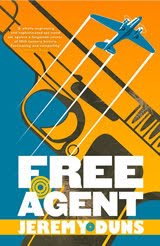
Free Agent is being published by Simon & Schuster in the UK in paperback next month (April 29). Here's the cover image:


And I've just this minute received the final cover artwork for the UK hardback edition of Free Country, the second book in the Paul Dark trilogy, which is mostly set in Italy. This will be published by S&S in August, and is already available to preorder at the usual places online. Click to get a much larger version.