‘The propagandist writes solely with the intention of appealing to his readers’ interest. He aims to hit, because he cannot afford to miss.
Accordingly his work is based on the formulae of modern advertising, to whose task his own runs broadly parallel.These words, written in April 1943, are contained in the syllabus used by the Special Training Schools of the Special Operations Executive. Variations of this syllabus were used in different training schools, but this passage comes from the one used by STS 103 in Canada, also known as Camp X, where members of SOE and OSS trained together.
It differs only in that the propagandist is at greater pains than the copywriter to disguise his medium. The reader of an advertisement should never be provoked into feeling: “This is only an advertisement.” The reader of propaganda should, if possible, never be allowed even to suspect that he is reading propaganda.’

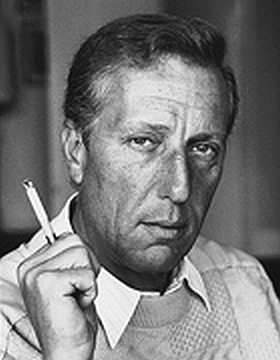
 As this document was used to train secret agents, its authors’ names do not appear anywhere in it, but we now know that it was written by two SOE instructors: Paul Dehn (left) and Kim Philby (right). Dehn, a poet and novelist, became a well-known scriptwriter after the war, working on the screenplays of both The Spy Who Came In From The Cold and Goldfinger. Philby went on to rise through the ranks of MI6 and was tipped by many to head it, but was eventually exposed as a double agent working for the Soviets, having been recruited while a student at Cambridge University in the 1930s.
There is a chilling irony in the fact that Kim Philby was one of the writers of the syllabus used to train British secret agents during the Second World War – and one has to wonder as a result how much of it might be propaganda. This is what James Jesus Angleton famously referred to as the ‘wilderness of mirrors’ that populates the world of espionage. Even when being taught about propaganda, you might be subject to it.
In October 1953, a new monthly magazine was launched in Britain: Encounter. An Anglo-American publication, it was a literary magazine that also discussed politics: it was liberal but anti-Communist. Its first editors were Irving Kristol and the poet Stephen Spender, and it was funded by the Paris-based Congress for Cultural Freedom. It became very influential, publishing the work of many of the most famous writers and thinkers of the day, including WH Auden, Vladimir Nabokov, Iris Murdoch and Bertrand Russell. But in 1967, it was revealed that the Congress for Cultural Freedom was a CIA front, and that most of the finance for the magazine had come straight from the CIA’s coffers, with the remainder being provided by the British Foreign Office’s innocuously named Information Research Department – in fact, a secret group dedicated to spreading anti-Communist propaganda. This isn’t a conspiracy theory but widely-documented fact, which the CIA itself acknowledges. Stephen Dorril discusses it at length in his book, MI6: Inside the Covert World of Her Majesty’s Secret Intelligence Service.
The idea for the magazine grew from meetings between MI6 and the CIA, who were looking for a way to influence the thinking of Britain’s liberal and left-wing intelligentsia. Steering the Congress for Cultural Freedom was CIA officer Michael Josselson, a former member of the Psychological Warfare Division. On the British side, the two leaders of the project were initially Tosco Fyvel, a member of the IRD who had been a close friend of George Orwell, and Malcolm Muggeridge, a senior journalist at The Daily Telegraph who also worked for MI6 ‘part time’. Muggeridge eventually grew disillusioned with the behind-the-scenes machinations and withdrew from the project. He was replaced by Goronwy Rees, another MI6 agent. But, to make matters a little trickier, we now know that before the war Rees had passed information to the Soviets, who had given him the codenames FLEET and GROSS.
Encounter’s readers could not, of course, be allowed to suspect that anything they read in the magazine might be propaganda. The merest hint of such a thought would mean the propaganda was ineffective. As a result, the CIA and MI6 left the majority of the magazine’s content alone. That way, it established itself and was soon taken by the intelligentsia in Britain as a genuine and unadulterated liberal voice. Articles that criticized censorship of the arts and other forms of repression behind the Iron Curtain were quietly encouraged, and articles that criticized American foreign or domestic policy were quietly discouraged. Stephen Dorril also reveals in his book the practice of MI6 agents writing articles in the press under pseudonyms, and discusses several such articles published by The Spectator in 1994.
As a result of this hornet's nest, figuring out today which of Encounter’s articles were written with no agenda and which were placed to plant ideas in readers’ minds is a difficult task. Similarly, some articles might have been written by authors who had no idea of the magazine’s real backers, but were published either because they coincidentally transmitted a desirable message, or because they served as good cover for other propaganda to be slipped between.

A good example of this can be found in the issue of May 1966, which I mentioned in my last blog post. The issue contains articles by, among others, Anthony Burgess, Eugène Ionesco, Robert Graves, Frank Kermode (by then an editor of the magazine), Tom Driberg, Malcolm Muggeridge and John le Carré. An extremely impressive line-up of contributors. Any of these articles might have been used by the CIA and MI6 for their own purposes, with the authors’ knowledge. Any may have been used by the CIA and MI6 without the authors’ knowledge. And any may have been used against the CIA and MI6, without their knowledge.
An example of the latter could be Tom Driberg’s article. Driberg was a prominent journalist, Labour MP and, later, Baron Bradwell. He was also gay, and on visiting Moscow in 1956 to interview the British double agent Guy Burgess, he regularly frequented a lavatory behind the Metropole Hotel to pick up men. The KGB showed him ‘compromising material’ of his visits there, and he was recruited as an agent as a result, and given the codename LEPAGE. One of his first acts was the publication of a book claiming that Burgess had never spied for the Soviet Union.
But Driberg broke off contact with the KGB in 1968, and his very dull 1966 article about Edith Sitwell is not a piece of propaganda for either side in the Cold War. Still, it is intriguing that a Soviet agent was writing articles in an MI6/CIA-fronted magazine. Especially considering Rees' involvement – one has to wonder whether the KGB tried to insert its own propaganda into the enemy's propaganda machine.
The article by John le Carré is also worth a closer look, but for very different reasons. Le Carré had worked for both MI5 and MI6, and knew Muggeridge, who had interviewed him just three months earlier for the BBC, as discussed in my last post. But in 1966 le Carré was firmly against American foreign policy, and it is hard to imagine a writer less likely to choose to work for the CIA. Even unknowingly, his article goes against what both MI6 and the CIA would have liked the magazine’s readers to think, because although he attacks many of the problems in the Soviet Union, he concludes that ‘there is no victory and no virtue in the Cold War, only a condition of human illness and a political misery’.
But I think John le Carré was unknowingly used in a different way: his article was one of the many hundreds of genuine ones published in Encounter that provided a suitable context in which MI6 and the CIA could insert a few articles that would make the points they wanted to make, and be taken seriously as a result of the background provided by others. I think one of these articles appears in this issue.
Titled ‘Africa Without Tears’, it was written by Rita Hinden, a socialist South African academic at the University of London, in reaction to news of a series of political murders that had taken place in Nigeria – murders that turned out to be the firing shots in what would become a lengthy civil war. I don’t know whether Hinden wrote the article on the behest of the CIA or MI6, but I think it may have suited their aims, as in it she essentially argued why everyone should turn a blind eye to the worsening political situation in Nigeria and, in effect, let the Africans get on with killing each other.
Hinden made this argument in a way that appears extremely heartless with the knowledge of the deaths that resulted in the civil war, but even without hindsight it is an example of the sort of bizarre double-think some intellectuals engaged in at the time. She develops her thesis over several thousand words, but I think a sense of what she was doing can be seen in the callousness of the title, and in the article’s final paragraph:
‘As long as we continue to regard Africans as a “special case” to be courted, flattered, excused, expected-greater-things-from, grieved-over, explained-away, we will still not have recognized that they have, once and for all, severed the navel cord which used to bind us. And Africans will continue to regard us with the irritation – merging eventually into pity – which marks the attitude of grown-up children to their anxious, ridiculous parents.’I have read this article many times, because my first novel was set in the Nigerian civil war. The article shocks me every time I read it. As well as being a contributor to Encounter, Hinden was the editor of a magazine called Socialist Commentary, which reflected the views of the pro-American right-wing of the Labour party at the time, and was also involved in the Fabian Society’s journal, Venture, which was funded by the Congress for Cultural Freedom. Michael Josselson described her as a ‘good friend of ours’ and said that the CIA relied heavily on her advice for their African operations.
This article of hers may not have been CIA propaganda, but it was nevertheless CIA-funded, and I think it was propaganda. Its aim was to plant the idea that post-colonial guilt is the real crime for which the article’s readers should feel guilty. It constitutes a ‘guilt complex’, and that ‘emotionalism’ is preventing people from seeing Africa in its proper perspective. Hinden suggested that anyone who felt that Britain had a responsibility to its former colonies was being condescending toward Africans – perhaps even racist. But her claim to respecting Africans was insincere, simply a pretence that offered readers a convenient excuse for ignoring a growing crisis in a country that, in 1966, had been independent just six years, following 160 years of British rule. It’s not callous to be indifferent to the situation in Nigeria, she argued: it’s treating them as the adults they want to be. The article plants some very unpleasant ideas, which were doubtless digested and repeated in conversations across England in various forms in May 1966 and after.
The British government did become involved in the war in Nigeria, but mainly as a supplier of arms to the side they thought had the greater chance of winning and continuing to supply them with oil. Many people in Britain didn’t feel the way Rita Hinden did, and were deeply shocked and moved by the events that took place in Nigeria and Biafra, and many did something about it. Many in Nigeria and Biafra were irritated by Western involvement, but many others were not, as their lives were saved by organizations such as the International Red Cross, Caritas and others.
In his BBC interview with John le Carré, Malcolm Muggeridge revealed with a mischievous glint in his eye that he had once been involved in intelligence. In fact, he still was. John le Carré didn’t reveal that he had also been an intelligence operative, and he did not know that he was about to be used by MI6 in a very elaborate propaganda operation. The part he played in the operation was a very small one: an article about James Bond, which expanded on some of the thoughts he had already expressed in his interview with Muggeridge. The article acted as a lure: it was featured on the cover of the magazine, and le Carré’s name would have attracted readers. But it also acted as cover, because readers of his article may also have read Rita Hinden’s, and been influenced by it. In his article, le Carré wrote of his own novel, The Spy Who Came In From The Cold:
‘I tried to touch new ground when I discussed the phenomenon of committed men who are committed to nothing but one another and the dreams they collectively evoke. At heart, I said, professional combatants of the Cold War have no ideological involvement. Half the time they are fighting the enemy, a good deal of the time they are fighting rival departments. The source of their energy lies not in the war of ideas but in their own desolate mentalities; they are the tragic ghosts, the unfallen dead of the last war.’There were, doubtless, many professional combatants during the Cold War who acted in just this way. But the irony is that, unknown to John le Carré, his own words were being used by men who did have an ideological involvement, and who were channeling their energies into the war of ideas.