Showing posts with label Dennis Wheatley. Show all posts

Thursday, February 10, 2011

From Sweden With Love

Spy novelist Jeremy Duns meets Iwan Morelius: friend, ally and accomplice to many of the world’s greatest thriller-writers

‘I was marched smartly across the dark, snow-covered parade ground and shown into an office where a man dressed in civilian clothes awaited me. He wasn’t a civilian, though, because he said, “I am Captain Morelius.” He had watchful grey eyes and a gun in a holster under his jacket. “You will come with me.”’
If you’re a fan of thrillers, this passage from Desmond Bagley’s 1977 best-seller The Enemy may contain a familiar, perhaps even comforting, element: the name Morelius. Over the years, characters with that name have appeared in thrillers by several writers. In Raymond Benson’s 2000 James Bond novel Doubleshot, for example, Dr Iwan Morelius is the plastic surgeon who operates on a mercenary to create a doppelganger of 007, while in Walter Wager’s 1982 thriller Designated Hitter, Colonel Iwan Morelius is a target for assassination.


But few people know of the real Iwan Morelius. A deeply tanned ex-soldier with a white beard, he looks fit and lively for a man in his seventies as we sit in the Stockholm sunshine discussing his remarkable place in the history of the thriller. For as well as his cameos, Morelius – also known as Iwan Hedman-Morelius or just Iwan Hedman – has been a friend, supporter and researcher for several renowned thriller-writers, and has known many more. I first noticed him mentioned in the Author’s Note of Colin Forbes’ The Stockholm Syndicate, and after coming across him a few more times decided to do some research. I eventually traced him to Spain, where he retired in the 1980s after a long career in the Swedish army, and we struck up a friendship over our shared love of vintage thrillers.

When I was at school in England in the 1980s, there was a healthy samizdat trade in creased paperbacks by the likes of Alistair Maclean, Frederick Forsyth, Jack Higgins and Dennis Wheatley. The latter provided the most illicit thrills. He is best known now, if at all, for his occult thrillers, but he also wrote epic swashbucklers and spy stories: they were racy, violent, fun books, with cliff-hangers at every turn, and they kept me awake many a night. Morelius had a similar experience. ‘I read my first Dennis Wheatley novel when I was eleven,’ he says. ‘That sort of book was forbidden to youngsters like me – there was sex in them. But for that reason they were quite interesting for a boy to read!’

In his twenties, Morelius joined the army, and started to collect Wheatley’s work. He discovered that Wheatley had written several books that had not yet been translated into Swedish, and in 1961 wrote to the author – ‘in bad English’ – and received a reply and a signed book. The two corresponded intermittently for years, and became friendly, eventually meeting. ‘Later on he called me Iwan. But at the beginning it was always Sergeant-Major. He was quite old-fashioned.’

Morelius didn’t just read Wheatley, though. He devoured works by Leon Uris, Ian Fleming, Donald Hamilton and others. He also wrote to them, and in many cases received replies. In 1968, he set up the magazine Detective Agent Science fiction Thriller, known as DAST, which opened more doors. His magazine promoted the work of dozens of British and American thriller-writers in Sweden, and Morelius soon found himself invited to conferences and other events, and became friends with several thriller-writers. Subscribers to DAST were given a special card and number: Leslie Charteris, creator of The Saint, had number 005, while Wheatley had 008 – 007 went to a friend at Bonnier’s, the Swedish publisher of Ian Fleming’s novels.


Morelius’ closest bond in the thriller world was probably with Desmond Bagley – known as Simon to friends – and he and his first wife frequently holidayed with the Bagleys. As well as their friendship, Bagley appreciated Morelius’ expertise on firearms, and consulted him on that and other subjects. The Tightrope Men, published in 1973, was set in Norway and Finland, and a key scene involved the failure of a Husqvarna Model 40 to fire at a crucial moment: Morelius had shown Bagley a peculiarity with the pistol’s barrel that meant if it were not forced back the trigger wouldn’t pull. The Enemy, published in 1977, was partly set in Sweden, and as well as featuring Morelius as a minor character was dedicated to Iwan and the other ‘DASTards’.

Morelius also struck up a friendship with Geoffrey Boothroyd, a Scottish gun expert who had written to Ian Fleming to tell him that the Beretta pistol 007 used in the early novels was ‘a ladies’ gun’, and advised him to change it to a Walther PPK. Fleming did, and immortalized Boothroyd as MI6’s armourer, Major Boothroyd of Q  Branch (the films changed the character to ‘Q’). Morelius has some splendid photos of Geoffrey Boothroyd both in Sweden and Scotland.

Morelius never met Ian Fleming, but he wrote and had bound and printed 007 – Secret Agent, a lavish reference work that only had four copies. One went to Hugh Hefner at Playboy, and Morelius shows me Hefner’s enthusiastic letter thanking him for it. But Ian Fleming is just about the only thriller-writer Morelius has not known or interviewed, and over the years he amassed an enormous collection of signed first editions, many of which he has since sold, as well as a photograph album that is both a private scrapbook and a behind-the-scenes archive of 20th century thriller-writers. Alistair Maclean, Leslie Charteris, Patricia Highsmith, Donald Hamilton, Helen MacInnes, James Leasor, Jon Cleary... he met them all. There’s a wonderful snap of Duncan Kyle, Ellery Queen and Desmond Bagley laughing together – all have similar owlish glasses and beards (they were often mistaken for each other) and the result is almost like a thriller version of the Marx Brothers. Here he is with Jack Higgins at his home in Jersey, and there’s John Gardner at an event at the Grand Hotel in Stockholm in 1981, where he demonstrated the gadgets on a specially designed Saab. Many give a sense of the community of thriller-writers that has developed at conferences and similar events over the last few decades, such as a photo of Desmond Bagley holding court to Jack Higgins, with Morelius looking on.  


Morelius later went into the publishing business himself, being commissioned by Swedish publisher Lindqvists in the ’70s to hand-pick his own line of books, which were sold as ‘Hedman Thrillers’. I suspect that it is, above all, his taste that has stood him in good stead as much as his passion and expertise for the genre, and talking to him, one quickly realizes that this is why so many writers were drawn to him. If you’ve sold millions of books, it can become hard to find anyone willing to give you honest feedback. But Morelius is the archetypal Swedish straight-talker. When Dennis Wheatley dedicated his novel The Ravishing of Lady Mary Ware to Morelius, he told his idol he was honoured, but also that he felt the novel had too much exposition, and pointed out several errors.

Even in retirement, Morelius keeps busy, editing the online thriller journal Läst & hört i Hängmattan  (‘Read and heard in the hammock’) with his wife Margareta in Spain. A stickler for detailed research, Morelius helped Desmond Bagley, Colin Forbes and several other writers create some landmark novels in the genre. If you find yourself reading a British thriller set in Scandinavia, he probably played a part somewhere behind the scenes, securing contacts, scouting locations, and digging out the type of local classified information that only true insiders can. When it came to my own debut thriller, Free Agent, as soon as I had a finished draft I sent it to Iwan for his view. His reply came a few agonizing days later, and was short but to the point: ‘Excellent. But there’s too much talking, and not enough action.’ I didn’t like to admit it but he was right, and I went back and rewrote several scenes as a result. I’m proud to have continued that thriller tradition.

Monday, June 14, 2010

Bourne Yesterday

It’s a familiar scene: a secret agent falls into the sea but manages to survive, with just one problem – he can’t remember who he is. Spy novelist Jeremy Duns takes a look at the surprising antecedents for Jason Bourne in some vintage British thrillers

‘He has a stolid face and solid musculature, which we know because he goes topless more than his leading ladies do. He has vigorous skirmishes on roofs, in cars and in hotel rooms. He takes as severe a beating – and shows as much emotion – as a crash-test dummy. He’s a government spy whom his government wants dead, and he’s mourning the violent death of his girlfriend. He so resembles another famous agent that you half-expect him to say, “The name is Bourne. Jason Bourne.”’
So ran Time’s review of the 2008 James Bond film Quantum of Solace (1). It was one of several that felt that the film was imitative of or influenced by the Jason Bourne films starring Matt Damon. The three films in the series to date, The Bourne Identity, The Bourne Supremacy and The Bourne Ultimatum, have grossed around one billion dollars globally, and are loosely based on the novels of the same name by Robert Ludlum, primarily The Bourne Identity. That novel features a man who is shot and falls into the sea, but manages to survive and make it to dry land. His former colleagues presume him dead, but he recovers, with one crucial setback: he has lost his memory, and has no idea that he is in fact a ruthless secret agent. On discovering his identity in a Swiss bank, he is stunned: ‘My name’s Bourne. Jason Bourne...’ (2)

The book was a worldwide best-seller on publication in 1980, as were its two sequels, and a new writer, Eric Van Lustbader, has written five more novels featuring the character since Ludlum’s death in 2001. The films took the central premise of Ludlum’s novel and fashioned new plots around it, reinvigorating the spy genre in the process. But that premise, of a secret agent on a mission presumed dead at sea, surviving, but discovering he has amnesia, has a surprising legacy of its own – and its most immediate precursor is Ian Fleming.

In the closing scenes of Fleming’s 1964 novel You Only Live Twice, James Bond is on a mission in Japan under cover as a local fisherman when he is hit on the head and plunges into the sea. He survives, but loses his memory:
‘When Kissy saw the figure, black-winged in its kimono, crash down into the sea, she sensed that it was her man, and she covered the two hundred yards from the base of the wall as fast as she had ever swum in her life. The tremendous impact with the water had at first knocked all the wind out of Bond, but the will to live, so nearly extinguished by the searing pain in his head, was revived by the new but recognizable enemy of the sea and, when Kissy got to him, he was struggling to free himself from the kimono.
At first he thought she was Blofeld and tried to strike out at her.
“It’s Kissy,” she said urgently, “Kissy Suzuki! Don’t you remember?”
He didn’t. He had no recollection of anything in the world but the face of his enemy and of the desperate urge to smash it. But his strength was going and finally, cursing feebly, he allowed her to manhandle him out of the kimono and paid heed to the voice that pleaded with him.
“Now follow me, Taro-san. When you get tired I will pull you with me. We are all trained in such rescue work.”
But, when she started off, Bond didn’t follow her. Instead he swam feebly round and round like a wounded animal, in ever-increasing circles. She almost wept. What had happened to him? What had they done to him at the Castle of Death? Finally she stopped him and talked softly to him and he docilely allowed her to put her arms under his armpits and, with his head cradled between her breasts, she set off with the traditional backward leg-stroke.
It was an amazing swim for a girl – half a mile with currents to contend with and only the moon and an occasional glance over her shoulder to give her a bearing, but she achieved it and finally hauled Bond out of the water in her little cove and collapsed on the flat stones beside him.
She was awoken by a groan from Bond. He had been quietly sick and now sat with his head in his hands, looking blankly out to sea with the glazed eyes of a sleepwalker. When Kissy put an arm round his shoulders, he turned vaguely towards her. “Who are you? How did I get here? What is this place?” He examined her more carefully. “You’re very pretty.”’ (3)
Bond comes to believe that he is his cover identity, Taro Todoroki. But his amnesia has a very unusual side-effect: he has become a complete innocent in matters of the flesh, having apparently forgotten ‘how to perform the act of love’. This is soon remedied, and Bond finally regains a glimmer of memory triggered by seeing the word ‘Vladivostok’. The novel ends with him leaving setting off for the Soviet Union, unaware that he is heading straight into enemy territory.

Robert Ludlum was a fan of Ian Fleming. In 1992, he wrote the following in an article for Entertainment Weekly on the 30th anniversary of the Bond films:
‘Fleming was a contemporary nexus, a vital connection, as well as a necessary contribution, that forced my generation of suspense writers to look deeper into the intrigues — political, geopolitical, and international — than we might have before he arrived in print. Fleming was a bridge over critical waters: He romanticized terrible inequities by obliterating them. But by doing so, he led those who followed him, followed in the wake of the extraordinary promotion and acceptance worldwide of the novels and the movies and eventually the videocassettes, to make those genuine inequities and intrigues perhaps — only perhaps — a touch more literary (a pretentious term, and certainly arguable).’ (4)
Ludlum certainly followed Fleming in The Bourne Identity. The opening and premise of the novel were both clearly inspired by the ending of You Only Live Twice: another writer’s musing on the idea of what might happen if James Bond forgot who he was. Fleming himself didn’t follow it up particularly satisfactorily; his next and last novel, The Man With The Golden Gun, opens with Bond returning to London. As he recaps to M what has happened to him since we last saw him, his journey between Japan and the Soviet Union is not explored:
‘“I'm afraid there's a lot I still can't remember, sir. I got a bang on the head” – he touched his right temple – “somewhere along the line on that job you sent me to do in Japan. Then there's a blank until I got picked up by the police on the waterfront at Vladivostok. No idea how I got there. They roughed me up a bit and in the process I must have got another bang on the head because suddenly I remembered who I was and that I wasn't a Japanese fisherman which was what I thought I was.” (5)
Bond has in fact been brainwashed by the Soviets and sent to London to kill M. When this fails, he is swiftly un-brainwashed and sent on a new mission, and his amnesia is never mentioned again. It seems Robert Ludlum felt that there was more mileage to be had from the premise, and spun out a new story along the lines of what a James Bond who had lost his memory might have gone through between leaving Japan and ending up on the waterfront at Vladivostok. Ludlum made his character an American agent and gave him some different characteristics from Bond, but the core idea is the same, and both Jason Bourne’s initials and the wording of his discovery of his identity make the homage to Fleming clear.

But, ironically, it seems that Ian Fleming’s idea for James Bond to lose his memory may also have had its roots in previous thrillers. In Dennis Wheatley’s novel Faked Passports, published in June 1940, British secret agent Gregory Sallust travels to Petsamo where, after taking a hit to the back of his head with a spent bullet, he finds he has lost his memory:
‘“Petsamo?” Gregory murmured vaguely. “Petsamo? Where’s that?”
“Wake up, man!” Freddie laughed. “It’s the Finnish port in the Arctic circle.”

A look dawned in Gregory’s eyes that none of them had ever seen before; a frightened, hunted look. “But, but–” he stammered, “the Arctic! What am I doing up in the Arctic?”

They all stood there in silence for a moment regarding him anxiously until, in a very small voice, Erika said suddenly:

“You do know me, darling, don’t you?”

“Of course I do,” he laughed uneasily. “As though I could forget your lovely face in a million years! But wait a minute – that’s very queer – I can’t remember your name.”

“I’m Erika,” she said softly.

“Erika,” he repeated. “That’s a pretty name, isn’t it – and marvellously suitable...”’ (6)
And just as In You Only Live Twice, amnesia has a very unusual effect on his sex life, as Erika laments:
‘In those hectic days they had spent in Munich and Berlin together early in November they had been the most passionate lovers. When they had met again in Helsinki his absence from her had seemed only to have increased his eagerness; but their opportunities for love-making had been lamentably few. Then his injury at Petsamo had changed his mentality in that respect as in all others. On waking on their first morning in the trapper’s house he had accepted quite naturally that he was in love with her, but it had been an entirely different kind of love. He was tender and thoughtful for her and followed her every movement with almost dog-like devotion, but he did not seem to know even the first steps in physical love-making any more.’ (7)
This is soon remedied, and Sallust regains his memory and completes his mission. It is likely that Fleming had read this novel: Wheatley was an acquaintance, and also a friend and close colleague of his brother Peter, who modelled the protagonist of his novel The Sixth Column on him. Wheatley was also one of Britain’s best-selling thriller-writers, and Fleming was a thriller aficionado. In addition, both the central plot premise of From Russia, With Love and many of the biographical details of James Bond in You Only Live Twice were influenced by another Wheatley novel, Come Into My Parlour. (8)

In Faked Passports, as in You Only Live Twice, the device of a secret agent contracting amnesia is more of an intriguing incident than a driving engine of the plot. Not so in Pray Silence by Manning Coles, published in October 1940, just six months after Faked Passports.

Coles was the pseudonym of two writers, Adelaide Manning and Cyril Coles. Their first novel, Drink to Yesterday, was published in March 1940 to great success (the jacket of the 1947 edition proclaimed it ‘The thriller that made Manning Coles famous in a day’). Drink To Yesterday is set in the First World War, and ends with British secret agent Tommy Hambledon being hit on the head and shoved into the sea while undercover as a German. His colleagues in London presume he has drowned. Pray Silence reveals he did not, but was washed ashore, discovered, and nursed back to health. Unfortunately, he has also forgotten who he is. He is presumed to be German, and presumes so himself. As ‘Klaus Lehmann’, he rises to become Deputy Chief of Police in Berlin until in 1933, gazing into the flames of the Reichstag fire, he suddenly remembers his true identity and resolves to get back in touch with London and defeat the Nazis:
‘“I am Hambledon, an agent of British Intelligence. Bill, where is Bill?”

There was a crash and a roar of flame as one of the floors fell in, and Hambledon looked up. That was the Reichstag burning. “Good God,” he thought, “and now I am a member of the Reichstag. It’s enough to make anybody feel faint, it is indeed.”’ (9)
Despite its quaintness and implausibility, Pray Silence is a beautifully constructed, witty and thoughtful spy thriller, and a real masterpiece of the genre. It led to twenty-four sequels. Tommy Hambledon doesn’t have a sex life to speak of, so we’re not told of the effect of his amnesia on it, but it seems clear that Fleming also read this novel, and combined the details of both it and Faked Passports to come up with a new twist on the idea. Amnesia is a staple plot device of thrillers, and it has taken many forms: doctors with amnesia, murderers with amnesia, and so on. But You Only Live Twice has four correspondences with Faked Passports: in both novels, a British secret agent is struck on the head, recovers to find he has amnesia, with the unusual side-effect that he has forgotten how to have sex. And it has six precise correspondences with Pray Silence: in both, a British secret agent on a mission under cover as a foreigner plunges into the sea, survives to discover he has amnesia, then believes he is the nationality of his cover identity, and is meanwhile presumed dead by his colleagues back home. Taken together, there are eight correspondences between You Only Live Twice and these two novels:

A British secret agent;
under cover as a foreigner;
is struck on the head; 
plunges into the sea;
recovers but finds he has amnesia;
which has the side-effect that he also forgets how to have sex;
He believes he is the nationality of his cover identity;
and is presumed dead by his colleagues.

This many correspondences seem unlikely to be coincidence, especially as Ian Fleming was both a keen thriller-reader and, as a journalist and former intelligence officer, something of a magpie. In his book on Operation Mincemeat, Ben Macintyre quotes a document written in September 1939 that, although signed by the Director of Naval Intelligence, Admiral John Godfrey, bore the hallmarks of having been written by Fleming, who was his personal assistant. The ‘Trout Memo’ was circulated to other wartime intelligence chiefs, and was a list of ideas for deceiving the Germans. Number 28 on the list was headed ‘A Suggestion (not a very nice one)’:
‘The following suggestion is used in a book by Basil Thomson: a corpse dressed as an airman, with despatches in his pockets, could be dropped on the coast, supposedly from a parachute that had failed. I understand there is no difficulty in obtaining corpses at the Naval Hospital, but, of course, it would have to be a fresh one.’
The idea stemmed from Thomson’s 1937 novel The Milliners’ Hat Mystery (10). Fleming was also interested in the fictional potential of amnesia: it featured in two of his other novels. The villain of Casino Royale was a displaced person at the end of the Second World War who feigned amnesia until being transferred to Strasbourg and adopting the name ‘Le Chiffre’. And in Moonraker, renowned British industrialist Hugo Drax is revealed to be the villainous Graf Hugo von der Drache, a former Nazi commando who in the latter stages of the war is captured while wearing a British uniform. Like Le Chiffre, he also pretends to have amnesia; he is nursed back to health as a missing British soldier by the name of Hugo Drax. This is somewhat similar to Pray Silence: Hambledon is the hero and genuinely has amnesia, but he is also nursed back to health by his enemies after being mistaken for one of them, and rebuilds his new life under a false identity he has adopted.

Pray Silence and Faked Passports were published just six months apart, and even in the fast-moving publishing schedule of the war it seems unlikely that they influenced each other. It is more likely that some earlier source triggered the thought in the minds of Dennis Wheatley and ‘Manning Coles’ that led to both their novels featuring British secret agents losing their memory: perhaps an earlier novel (although I haven’t found any), or a news item about a soldier returning from war with amnesia, or something similar. In Pray Silence, the idea has a pleasing neatness to it: what if a secret agent were under cover on a mission, somehow lost their memory, and ended up believing that they were their cover identity? In Faked Passports, the idea is a strangely ineffective digression that misses the idea’s potential: Gregory Sallust is not under cover and so does not believe he is anyone else.

We may never know where the idea originally sprung from, but the ripples of it can be traced from 1940 onwards. It seems likely that Ian Fleming read both these novels and refashioned the concept into a new mixture to his own taste, featuring James Bond in Japan. Some sixteen years later, the chain continued with Robert Ludlum presenting a fresh twist on the idea. It has taken on several more forms since, from the film The Long Kiss Goodnight to the graphic novel series XIII.

Ludlum has had his own followers, and the recent Bond films have certainly taken inspiration from the Bourne films, bringing the story full circle. The influence of Ian Fleming’s novels, and the vintage British thrillers that influenced them, continue to live on in surprising ways.


References
1. Quantum of Solace: Bourne-Again Bond by Richard Corliss, Time , November 13, 2008.
2. p61, The Bourne Identity by Robert Ludlum, Granada, 1980.
3. pp181-182, You Only Live Twice by Ian Fleming, Pan, 1966.
4. James at 30 by Robert Ludlum, in Entertainment Weekly, Issue #123 June 19, 1992.
5. p21, The Man With The Golden Gun by Ian Fleming, Pan, 1967.
6. pp249-250, Faked Passports by Dennis Wheatley, Arrow, 1966.
7.p404, Faked Passports.
8. For more on this, see The Secret Origins of James Bond.
9. p40, Pray Silence by Manning Coles, Hodder & Stoughton, 1953.
10. pp6-7, Operation Mincemeat, Ben Macintyre, Bloomsbury, 2010.

Wednesday, May 5, 2010

Commando Bond

Spy novelist Jeremy Duns takes an in-depth look at 007's ties to special forces

'MI6 looks for maladjusted young men who'd give little thought to sacrificing others to protect Queen and country. You know – former SAS types with easy smiles and expensive watches…'

So says Vesper Lynd to James Bond in the 2006 film Casino Royale. Although it doesn’t get as much mileage in the finished film as it did in the press before its release, Casino Royale took a daring approach to the Bond mythos, presenting an ‘origin story’ for the character. Bond is a newly appointed member of MI6’s Double O Section – the film opens with him earning his stripes by cold-bloodedly murdering a traitor – and it would appear from his reaction to Vesper’s comment that she has hit home and that he is in fact a 'former SAS type'. This was confirmed by the film's official website, which provided a chronology of Bond's pre-MI6 career, including a military dossier detailing his time at Britannia Royal Naval College, his intelligence role on HMS Exeter and special forces training at Plymouth and Brize Norton. The site even claimed Bond had been part of an invented outfit called '030 Special Forces Unit'.

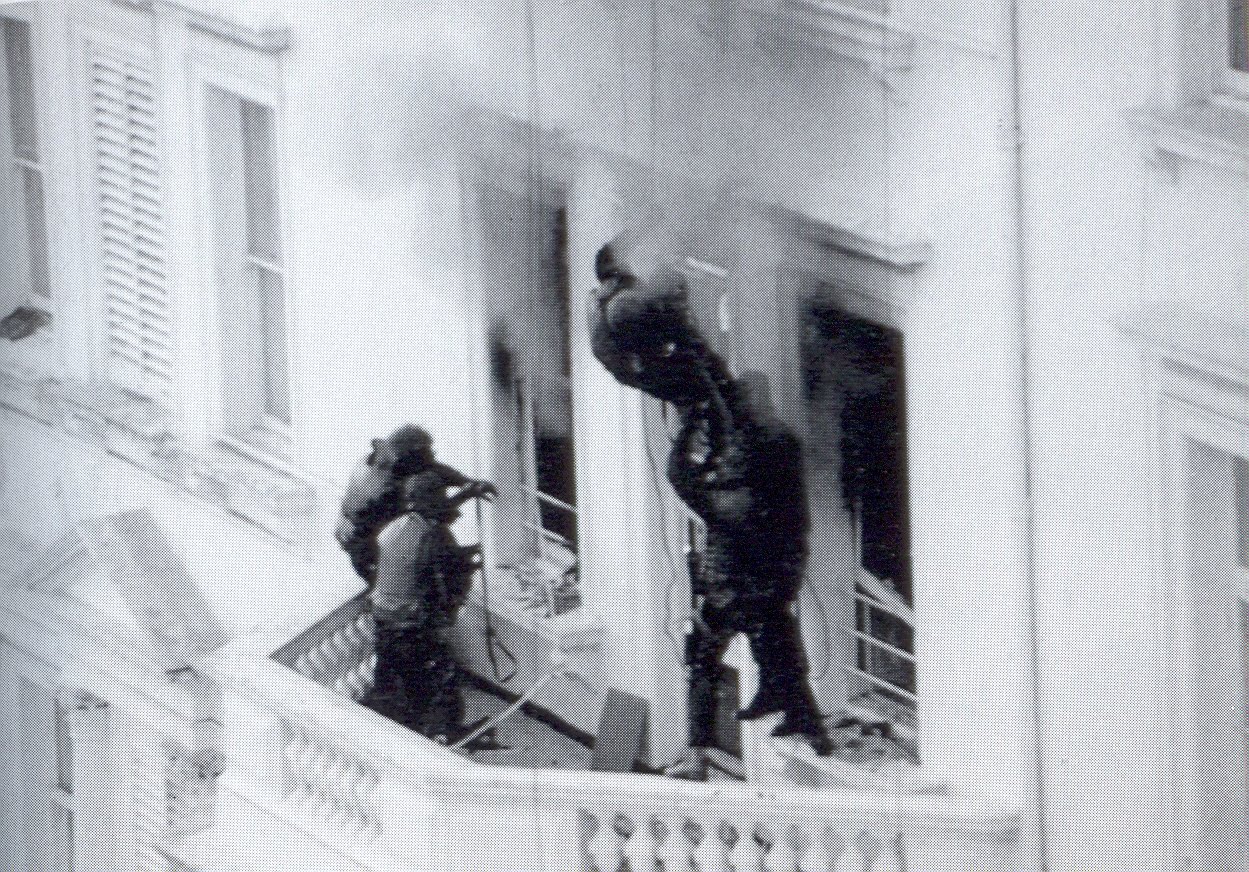
Special forces have developed a particular image in popular culture in recent years. Britain's SAS is probably the world’s best known special forces outfit, having featured in dozens of films, books and magazine articles, many of them generated by the worldwide media interest surrounding the storming of the Iranian Embassy in London in 1980 after terrorists took hostages inside, which was screened live on British television (pictured).

Members of the SAS have a popular image as gung-ho operators who shoot first and ask questions later: not really the type to create their own cocktails (or sport easy smiles). The use of tough SAS types in fiction has also become something of a cliché, with a whole genre being formed in the wake of Andy McNab's 1993 memoir of an SAS operation in Iraq, Bravo Two Zero. It's not quite James Bond territory. Or...?

In an article in Time published on November 10 2002, shortly before the release of Die Another Day, Lee Tamahori, the director of that film, made the following remark about the direction he felt the character had been taken in the previous few films:
‘“I was worried that he was turning into an SAS man, machine-gunning everyone,” says Tamahori. “I've been trying to make him more of an Ian Fleming Bond.”’
This is a misapprehension. While copious use of a machine gun is not a hallmark of Ian Fleming’s novels, the idea that James Bond might be an SAS man is not out of keeping with them. In fact, Fleming included several clues that point to James Bond having just such a type of background.

The Special Air Service did not always have the popular reputation it has today. The group was founded by David Stirling (left) in 1941 to undertake acts of sabotage behind enemy lines. The son of a Scottish general, Stirling began a degree in architecture at Trinity College, Cambridge, but his studies were curtailed by his fondness for the local nightlife. He was eventually read out a list of 23 offences and asked to choose the three for which he wished to be sent down. He then decided to become the first man to climb Everest and enlisted in the Supplementary Reserves of the Scots Guards – he trained in the Swiss Alps and the Rockies. When war broke out he was 24, and was sent to the Guards Depot in Pirbright:
'Pirbright was a mere hour from the attractions of London. During one lecture, possibly after a night at White's Club or the gaming tables, Stirling fell asleep. He probably fell asleep in many, but on this occasion he was woken by the lecturer, asking him to repeat what had just been said. Stirling repeated it verbatim.'1
After this, Stirling volunteered for an expeditionary force setting off to fight a winter campaign in Finland – ski training was in Chamonix – before joining the commando group Layforce, after which he founded the SAS.

It is difficult to imagine a more 'James Bondish' background than this, but Stirling is one of the few leading commandos from World War Two not to have been claimed as a model for 007. Fleming was certainly inspired by the real-life experience of such men, however, as he made clear in an interview with Playboy published after his death:
'I think [Bond is] slightly more true to the type of modern hero, to the commandos of the last War, and so on, and to some of the secret-service men I've met, than to any of the rather cardboardy heroes of the ancient thrillers.'2
Fleming knew several heroic commandos and secret-service men who had served in the war. Perhaps the best known among them is Patrick Leigh Fermor, who worked for the Special Operations Executive (SOE) in Crete, where he led the party that kidnapped General Kreipe in 1944. That mission was immortalised in W Stanley Moss' book Ill Met By Moonlight, published in 1950, which was made into a film in 1957, with Dirk Bogarde playing Leigh Fermor.

In an afterword for the 2001 edition of Moss' book, Leigh Fermor wrote about the operation for the first time. He modestly refuted the 'Baroness Orczy - John Buchan - Dornford Yates' status that the episode has gained over the years, but at the same time revealed that during a prolonged stay in Cairo with SOE colleagues, the villa they had stayed in had been filled with gelignite disguised as goat's droppings, magnetised trouser buttons that turned into compasses and gossamer-thin maps stitched into the lining of clothing. Many of these items were created by a Major Jasper Maskelyne, who Leigh Fermor recognised as a stage magician he had seen perform in London as a child 3.

After the war, Leigh Fermor took up writing, drafting some of his first book, The Traveller's Tree, during a stay at Goldeneye in 1948. He loved Fleming's Jamaican retreat and commented in his book that it could become a model for new houses in the tropics 4. The two men became friends, and Fleming repaid Fermor’s plug for Goldeneye by quoting a long passage on voodoo from The Traveller's Tree in Live and Let Die.

Another of Fleming's friends mentioned in his novels was David Niven, whose manners Kissy Suzuki so admires that she names her cormorant after him. Niven also served as a commando of sorts in World War Two: while serving with 'Phantom', the regiment responsible for ferreting out information in forward areas and radioing it back to GHQ, he worked on joint operations with the SAS, whose command it came under from 1944 5.

Another friend, Antony Terry, was captured during Operation CHARIOT, the daring commando raid on the harbour installations at Saint-Nazaire in 1942, and was awarded the Military Cross for it 6. After the war, he worked for Fleming's Mercury News, as well as continuing his contacts with MI6, and in 1960, he guided Fleming around Berlin, helping him with much of the research for the short story The Living Daylights 7.

Closer to home, Ian Fleming's brother Peter was also engaged in commando work during the war. In 1940, he and 'Mad Mike' Calvert – who later found fame with the SAS – prepared for a guerrilla defence of Britain in the event of a German invasion. Later that year, Peter Fleming led a reconnaissance party into the Norwegian port of Namsos and the following year he formed and took a small commando team to Greece (the latter mission under the auspices of SOE). Neither expedition was a great success: Peter was reported to have been killed in Norway and an obituary even ran in The Daily Sketch, causing his family great distress until he arrived, alive and well, in Scotland. It may be that this episode later gave Ian the idea for Bond's false obituary in You Only Live Twice: it can be useful for a secret agent to have the world believe him dead.

In Greece, the Yak Mission, as Peter's group was nicknamed, wrecked the path of advancing German paratroops – Peter even booby-trapped a bridge by fitting a London double-decker bus with flame-throwers on it – before it was attacked from the air near the island of Milos. A 400-ton yacht that had been commandeered by the Navy burst into flames and sank, and Peter was again very lucky to come out alive 8.

Playing Red Indians

Peter Fleming was also a celebrated travel writer and journalist. His novel The Sixth Column, published in 1951, was a gentle send-up of the thrillers he had enjoyed growing up, and was dedicated to Ian, also an aficionado of the genre. One of the main characters is a former commando called Archie Strume, who has great success with a thriller based on his war-time experiences called Hackforth of The Commandos. Colonel Hackforth is always saying things like:
'Tell the Minister of Defence to have a midget submarine alongside the Harwich customs jetty not later than last light on Tuesday. It's important.’9
The Sixth Column may have been a spur for Ian Fleming to knuckle down and write his own thriller, which he had been promising to do since the war: he started writing Casino Royale just a few months after the publication of his brother’s book. Archie Strume and Colonel Hackforth were partially based on the author Dennis Wheatley – who Peter had become friends with during the war – and his secret agent character Gregory Sallust, but the references to wartime commando adventures involving midget submarines may have been for Ian’s eyes only.

In 1942, Ian Fleming set up what he liked to call his ‘Red Indians’. No. 30 Assault Unit was a small roving commando outfit made up of men from the Army, Navy, Marines and Air Force. Its task was to go in after the first wave of Allied attacks and scavenge for technical intelligence: codes, weapons, equipment, maps and documents left behind by the Germans. The commanding officers were Dunstan Curtis, who had played a leading role in the Saint Nazaire raid, and the Antarctic explorer Quentin Riley 10.

One of 30 AU’s most enterprising officers was Lieutenant-Commander Patrick Dalzel-Job RNVR, who led missions in France, Belgium and Germany in the latter stages of the war. Dalzel-Job had an unusual background: after the death of his father in the Somme, he spent his formative years in Switzerland, where he learned to cross-country ski and speak French fluently. While still in his twenties, he built his own schooner and sailed to Norway with his middle-aged mother and a Norwegian schoolgirl as his crew.

This experience stood him in good stead when the war came. In April 1940, when Peter Fleming was in Namsos, Dalzel-Job was in Narvik, where he countermanded orders not to evacuate civilians. Later on, he worked behind the scenes developing the Royal Navy’s midget submarines, used in the attack on the Tirpitz, and finally went behind enemy lines with 30 AU, where among other things, he accepted the formal surrender of the city of Bremen and captured the Nazis’ own midget submarines.

Dalzel-Job did not care overly for his boss back in London, finding Ian Fleming cold, austere and egotistical, although he appreciated his ‘amusing and pungent’ minutes on operational intelligence reports 11. Dalzel-Job’s ‘Nelson touch’ even brought him into conflict with Fleming at the end of the war, when he sent a signal to the British Flag Officer in Oslo as though it were from the Admiralty, sending himself on a fairly pointless mission to Norway so he could find the schoolgirl he had sailed with before the war. Fleming was furious at not being consulted, and gave Dalzel-Job an earful about it, but off he went, found the girl, and married her.

Another member of 30 AU who saw action in France was Tony Hugill. Also a lieutenant-commander in the Royal Naval Volunteer Reserve , he was awarded the Croix de Guerre for his part in D-Day and won the Distinguished Service Cross for taking the surrender of 280 troops under a Luftwaffe officer at a radio station near Brest. From 1945-6, he led the Forward Interrogation Unit in Hamburg, Germany.

After the war, Hugill went into the sugar industry, managing Tate and Lyle's West Indian operations between 1954 and 1966. In Fleming's last novel, The Man With The Golden Gun, Bond is vouched for by local sugar executive Tony Hugill, who, we learn in Chapter 4, was in Naval Intelligence during the war: 'sort of Commando job'. Bond's cover name for this mission, Mark Hazard, may have been inspired by the title of Hugill's war memoirs, The Hazard Mesh, published in 1946, but if so Fleming either hadn't read the book or was in a generous mood, because Hugill's depiction of him (although he is not named) is not flattering:
'One of the Admiralty pundits signalled us that he was about to honour us with a visit. We none of us liked him much. He was one of those very superior professorial type R.N.V.R.s who got their claws into Their Lordships early in the war and have kept them in ever since. As our proprietary deity he felt himself entitled to demand offerings of Camembert and libations of captured cognac of the better sort (But my dear feller this stuff's undrinkable!) from time to time. He also interfered with us on a higher level.'12
In contrast to the popular perception of commandos today, the British commandos Fleming knew from the war were often, beneath their tough exteriors, cultured men of great sensitivity: Patrick Leigh-Fermor and Peter Fleming were both acclaimed travel writers, Tony Hugill’s memoirs are filled with poetry and Patrick Dalzel-Job’s autobiography is, at root, a love story.

Fleming never saw action in the field himself, although he may have liked to have done. John Pearson recounted in his biography that Fleming liked to tell people, Gatsby-ishly, that he had once killed a man, but that the story seemed to change with each telling 13, and some of his other claims of prowess have been similarly questioned.

This sense of inconsistency extended to James Bond. In his fiction, Fleming made use of those real-life episodes he found most fascinating and exciting; ensuring that all of his novels' re-imagined tidbits meshed together was of secondary concern. For example, Fleming fans the world over know that James Bond killed twice in cold blood to obtain his licence to kill – nobody cares to dwell on the irritatingly inconvenient sentence in Chapter 19 of From Russia, With Love in which Fleming baldly states:
'Bond had never killed in cold blood.'
The two killings described in Casino Royale are both examples of operations usually undertaken by special forces: assassinations. Governments and conventional intelligence services cannot be seen to sanction extra-judicial murder, so such jobs inevitably fall to less accountable units. As Bond's second kill, in Stockholm, involved a Norwegian 'who was doubling against us for the Germans', it appears that both these missions took place during the war. According to MRD Foot’s official history of the SOE, Stockholm had been the initial base for that organisation’s activity in Scandinavia 14, so perhaps Fleming had heard of a similar operation through intelligence contacts and embellished it 15.

Bond's first 'wet job', in New York's Rockefeller Center, was inspired by Fleming's visit to the British Security Co-ordination's offices in the same building in June 1941; he accompanied BSC officers as they burgled a Japanese cipher clerk's office on the floor below theirs 16. The clerk was unharmed, but SOE, whose affairs in the Western hemisphere were controlled by the BSC in New York 17, did have an assassination capability. This was officially abandoned at the end of the war, but many SOE officers joined MI6, so the expertise may have remained in place 18. During the war, SOE operatives were commonly referred to as ‘terrorists’ by the Nazis; MRD Foot, who was a member of SAS during the war, recalls being captured and over-hearing one of his interrogators saying: ‘If he is a terrorist he is shot at once’ 19.

After the war, the SAS evolved into more of a counter-insurgency regiment; the 1969 Army Training manual stated that its tasks included 'the ambush and harassment of insurgents, the infiltration of sabotage, assassination and demolition parties into insurgent-held areas, border surveillance liaison with, and organisation of friendly guerrilla forces operating against the common enemy' 20. The SAS executed some of these responsibilities in the Mau-Mau rebellion in Kenya during the 1950s and in Aden in 1967 21. More recently, it has seen action in Aghanistan, Northern Ireland, Gibraltar and, latterly, Iraq.

Despite the above rather lurid description, members of the SAS have not always approved of assassination. When I asked former SAS sergeant Jacques Goffinet in 2005 if he had been tempted to assassinate Joachim von Ribbentrop when he discovered him in hiding in a flat in Hamburg in June 1945, he replied simply: 'That would have made me as bad as them.'22

James Bond is often concerned with the same dilemma: outside of the episodes mentioned in Casino Royale, he makes for a rather shaky assassin. In the short story Octopussy, he travels to Jamaica on a private war crimes investigation. His target is Dexter Smythe, who as a member of the Miscellaneous Objectives Bureau – a (fictional) wartime commando outfit formed by the Secret Service and Combined Operations – had murdered one of his early mentors. But while Bond had no qualms about murdering double agents or cipher clerks, this time he does not draw his weapon, leaving Smythe the options of suicide or disgrace.

In The Living Daylights, Bond's mission is strategically defensive – to stop another assassination – but here he also has reservations, and deliberately muffs the assignment because of the 'sharp pang of longing' he feels for his female target – a sackable offence, as he admits himself at the end of the story. In For Your Eyes Only, Bond undertakes the mission to assassinate Von Hammerstein as retribution for the murder of M's friends: an 'eye for an eye' job. In the event, however, the deed is done by the friends' daughter, although Bond kills another of the villains and comforts the girl afterwards. In The Man With The Golden Gun, Bond is a little less circumspect, eventually shooting Scaramanga five times.

The use of weapons

James Bond is neither straightforward assassin nor pure commando in Ian Fleming's novels: most of the time he works as a counter-espionage agent, sent by M to head off an emerging threat, rather than initiating offensive action against the enemy. Nevertheless, Fleming incorporated many details of war-time commandos into his novels: apart from the references to old colleagues and friends who had been involved in special forces, Q Branch's weapons and gadgets parallel the work done by similar departments in SOE and elsewhere. Bond's self-reliance and stamina are reminiscent of the commando ethic, as is his basic fitness regimen described in Chapter 11 of From Russia, With Love. His habit of taking Benzedrine was also common practice among commandos during the war, when remaining alert for long periods was often necessary.

Bond is also a martial arts aficionado – we know from M's obituary in You Only Live Twice that he founded the first judo class in a British public school. In Chapter 10 of the same novel, Tiger Tanaka tells Bond he will show him one of his service's secret ninja academies in the mountains, and Bond replies that MI6 also has a commando training school for unarmed combat attached to its headquarters. This is an example of Fleming carrying details across his books successfully, because in Chapter 8 of Moonraker Bond is happy to have his Unarmed Combat class with 'that dam' Commando chap' cancelled for a meeting with M. He is clearly a good student, though, because in the first chapter of Goldfinger we find him nursing the hand that has killed a Mexican with a 'Parry Defence against Underhand Thrust out of the book' and a hand-edge blow to the Adam's Apple that had been 'the standby of the Commandos'. A little later, in Chapter 5, we learn that Bond is writing Stay Alive!, a 'handbook of all methods of unarmed combat'.

But Bond also uses weapons, of course. In Chapter 18 of Live and Let Die, he tries to kill an octopus using a commando dagger 'of the type devised by Wilkinson's during the war'. This would be the Fairbairn-Sykes Fighting Knife (pictured), issued to the SAS and other special forces outfits and eventually adopted as the Commando Association's emblem. It is still made by Wilkinson's, still in use by British special forces 23 and is currently the shoulder-flash of the Royal Marine Commandos 24.

The idea that this character has had some sort of experience with special forces is not implausible – but what form might that have taken? In his book The James Bond Dossier, Kingsley Amis wondered what a Commander from Naval Intelligence had been doing in the Ardennes sector in 1944 25 (which Bond recollects in Chapter Nine of Dr No). This may simply have been an oversight on Fleming's part, like the 'cold blood' boo-boo in From Russia, With Love, but it may also have been deliberate. In his obituary in You Only Live Twice, M tells us that Bond joined the Special Branch of the RNVR in 1941. Between that date and 1944, Peter Fleming undertook missions for both MI R and SOE; army intelligence officer Antony Terry was captured in a naval commando raid; RAF men took part in 30 AU's amphibious landings with Royal Naval Commandos; and Patrick Leigh Fermor and SOE colleagues arranged for guides to help Special Boat Service (SBS) officers across the mountains of Crete 26.

World War Two was a time of irregular warfare, and resourceful young men barging into offices in Whitehall demanding to mount their own raids against the Nazis were surprisingly common. Dozens of small commando units were formed, changed names or were subsumed into larger groups during the war, and as a result some enterprising men had extremely varied resumes by the cessation of hostilities. Churchill also set up Combined Operations under Lord Mountbatten, which ensured that commando groups worked together (like Dexter Smythe's outfit in Octopussy). For Operation FRANKTON, for example, a raid on Bordeaux Harbour in December 1942, the Royal Marine Boom Patrol's Detachment used limpet mines that had been developed by SOE 27 – or 'those things our saboteurs used against ships in the war', as Bond describes them in Chapter 15 of Live and Let Die (later in the book he attaches a limpet mine to the hull of the Secatur). FRANKTON was masterminded by Herbert ‘Blondie’ Hasler, who went on to play a leading role in the founding of the Special Boat Service (SBS), a sister service to the SAS. The operation was the subject of the 1955 film The Cockleshell Heroes, produced by Cubby Broccoli and co-written by Richard Maibaum.

Against this background, it is not so unlikely for someone in the Special Branch of the RNVR to have heard machine-gun fire in the Ardennes. Unless Fleming meant for Bond to have been an infantry soldier at the Battle of the Bulge – which seems even more unlikely for someone in the RNVR – by far the most likely way for him to have been in the area would have been on a special forces mission. SOE's Operation CITRONELLE, which sought out maquis in the Ardennes in April 1944, for example: he could have been a member of one of the famous Jedburgh teams, all of which contained one Brit, one American and one Frenchman – early training for working with Felix Leiter and René Mathis, perhaps! SOE produced more than its fair share of successes during the war: one of its best-known agents was the Polish-born countess Krystyna Skarbek, best known as Christine Granville. 28

However, the most plausible explanation would be that Bond was seconded to the SAS: it drew and still draws men from all armed forces (the 'Air' in its name was used to fit in with an earlier deception operation), and undertook several missions in the Ardennes during 1944 29. Fleming may have heard about one of these operations from David Niven or another friend who had worked with the regiment, and stored it away as being a suitable field of operation for Bond during the war. 30 AU also undertook reconnaissance work in Belgium at around this time.

Post-Fleming, 007’s special forces ties have often been emphasized: John Gardner – who served in the Royal Marines’ 42 Commando during the war – had Bond train with the SAS and the SBS in his novels 30, and the relationship has been even more overt onscreen: the closing scenes of many of the films, for example, are spectacular commando-like raids on villains' lairs. HALO jumps, bungee jumps, parachute landings and shooting while skiing are all areas of special forces expertise. Casino Royale continues the series' habitual nods to special forces work: as well as Vesper's appraisal, Bond holds up an embassy single-handedly and engages in plenty of hand-to-hand combat – he seems to have paid attention in his classes with that dam' Commando.

In his introduction to the 2005 edition of Jane’s Specal Forces Recognition Guide, Lieutenant-Colonel Ewen Southby-Tailyour, a veteran of four commando outfits, wrote that the dividing line between forces – military, police, special and elite, intelligence-gathering or other – is often blurred, especially in the military, and pointed to the then- (and still-) current geo-political climate as a catalyst for the increasing use of special forces’ unconventional methods:
‘It might now be argued that with the general proliferation of worldwide terrorism all military forces and most police forces should be trained for unconventional operations: certainly there should be considerably more awareness of, and training for, asymmetric warfare.’31
The Bond novels and films have never purported to be plausible portrayals of clandestine work: they are fantastic adventures with one toe in the real world. James Bond is an amalgamation and elaboration of the most exciting bits of espionage and commando lore, filtered through the prodigious imagination of his creator. He is not, therefore, an out and out commando. But as a back story for the character, 'former SAS type' is not out of place: it is entirely fitting with his heritage.

I would like to thank MRD Foot and Lieutenant-Colonel Ewen Southby-Tailyour for their help and advice with this article.

References

1. p4 The Originals: The Secret History of The Birth of the SAS In Their Own Words by Gordon Stevens, Ebury Press, 2005.
2. The Playboy Interview: Ian Fleming by Ken Purdy, Playboy, December 1964.
3. pp193 and 205-206 Ill Met By Moonlight by W Stanley Moss, The Folio Society, 2001: afterword by Leigh Fermor.
4. p327 The Traveller’s Tree by Patrick Leigh Fermor, Penguin, 1984.
5. p139 The SAS: The Official History by Philip Warner, Sphere Books, 1983; and obituary of Captain Charles Moore, The Daily Telegraph, 13th May 2004.
6. p ix The Greatest Raid Of All by CE Lucas-Phillips, Little, Brown, 1960.
7. p371 Ian Fleming by Andrew Lycett, Phoenix, 1996.
8. pp221-227 and 239-255, Peter Fleming: A Biography by Duff Hart Davis, Oxford University Press, 1987.
9. p23, The Sixth Column by Peter Fleming, Tandem, 1967.
10. p134, The Life of Ian Fleming by John Pearson, Companion Book Club, 1966.
11. p115 Arctic Snow to Dust of Normandy: The Extraordinary Wartime Exploits of a Naval Special Agent by Patrick Dalzel-Job, Pen & Sword, 2005.
12. p60 The Hazard Mesh by JAC Hugill, Hurst & Blackett, 1946.
13. p210 Pearson.
14. p208 SOE: 1940-1946 by MRD Foot, BBC, 1984.
15. As well as his colleagues in Naval Intelligence, Fleming crossed paths with many people involved in clandestine work during the war. For example, on November 10 1942 he had dinner at the home of the thriller-writer Dennis Wheatley, who was then involved in devising deception operations with the Joint Planning Staff of the War Cabinet. Fleming was accompanied by Joan Bright, an assistant to General Ismay, Churchill’s Chief of Staff; the two other guests were Roland Vintras, also of the JPS and later a Director of Air Intelligence, and Colin Gubbins, later head of SOE. One can imagine that such dining partners may have given the future thriller-writer many ideas. Phil Baker (Wheatley biographer), personal communication. For more on this, and Wheatley's influence on Fleming's work, see my article The Secret Origins of James Bond.
16. p124 Pearson.
17. p42 Foot.
18. pp 611-612 MI6: Inside the Covert World of Her Majesty's Secret Intelligence Service by Stephen Dorril, Touchstone, 2000.
19. p57 Foot. James Bond is also described as a terrorist, of course, in his MGB file in Chapter Six of From Russia, With Love. Incidentally, Foot feels that Fleming was one of the few non-SOE officers in Britain’s wartime intelligence organisations to appreciate SOE’s worth (personal communication, November 17 2007).
20. British Army Land Operations Manual, volume 3, counter-revolutionary operations. Cited in British Intelligence and Covert Action by Jonathan Bloch and Pat Fitzgerald (London 1982), p42.
21. The SAS, their early days in Ireland and the Wilson Plot by Alexander Platow (Seán Mac Mathúna), first published in Lobster 18 (1989).
22. See Whisper Who Dares by Jeremy Duns, June 16 2005, The Bulletin, Brussels; reprinted in 5 SAS' Veterans' News, Issue 70, 2005, and at this site here.
23. p389 Jane's Special Forces Recognition Guide by Ewen Southby-Tailyour, Collins, 2005.
24. p47 British Commandos 1940-1946 by Tim Moreman, Osprey, 2006.
25. p17 The James Bond Dossier by Kingsley Amis, Signet, 1966.
26. p194 Leigh Fermor afterword, Moss.
27. p36 Cockleshell Heroes by CE Lucas-Phillips, Pan, 1974.
28. Granville has been repeatedly claimed to have been Fleming’s model for Vesper Lynd following a post-war affair with the author. The source for this appears to be p151 17F: The Life of Ian Fleming by Donald McCormick, Peter Owen, London, 1993. McCormick was a hoaxer, notably on matters related to Jack the Ripper, and I believe that he fabricated the evidence for this plausible-sounding assumption. Regardless, there seem very few similarities between Granville and Vesper Lynd other than their both being beautiful female agents with dark hair.
29. Ewen Southby-Tailyour does not agree with me on this point, being adamant that Fleming’s Bond would have been more likely to have been SBS than SAS. He points to Bond’s naval background and the fact that every member of the SBS was trained in skiing, parachuting, mountaineering and combat (underwater) swimming – but very few members of the SAS undertook training in all of these (personal communication). However, the SAS often collaborated and exchanged personnel with naval units during the war, and the SBS never undertook any operations in the Ardennes.
30. p15, Icebreaker by John Gardner, Berkley, 1983; and p28 Scorpius by John Gardner, Charter, 1990.
31. pp6-7 Introduction, Jane's Special Forces Recognition Guide.