'MI6 looks for maladjusted young men who'd give little thought to sacrificing others to protect Queen and country. You know – former SAS types with easy smiles and expensive watches…'
So says Vesper Lynd to James Bond in the 2006 film Casino Royale. Although it doesn’t get as much mileage in the finished film as it did in the press before its release, Casino Royale took a daring approach to the Bond mythos, presenting an ‘origin story’ for the character. Bond is a newly appointed member of MI6’s Double O Section – the film opens with him earning his stripes by cold-bloodedly murdering a traitor – and it would appear from his reaction to Vesper’s comment that she has hit home and that he is in fact a 'former SAS type'. This was confirmed by the film's official website, which provided a chronology of Bond's pre-MI6 career, including a military dossier detailing his time at Britannia Royal Naval College, his intelligence role on HMS Exeter and special forces training at Plymouth and Brize Norton. The site even claimed Bond had been part of an invented outfit called '030 Special Forces Unit'.
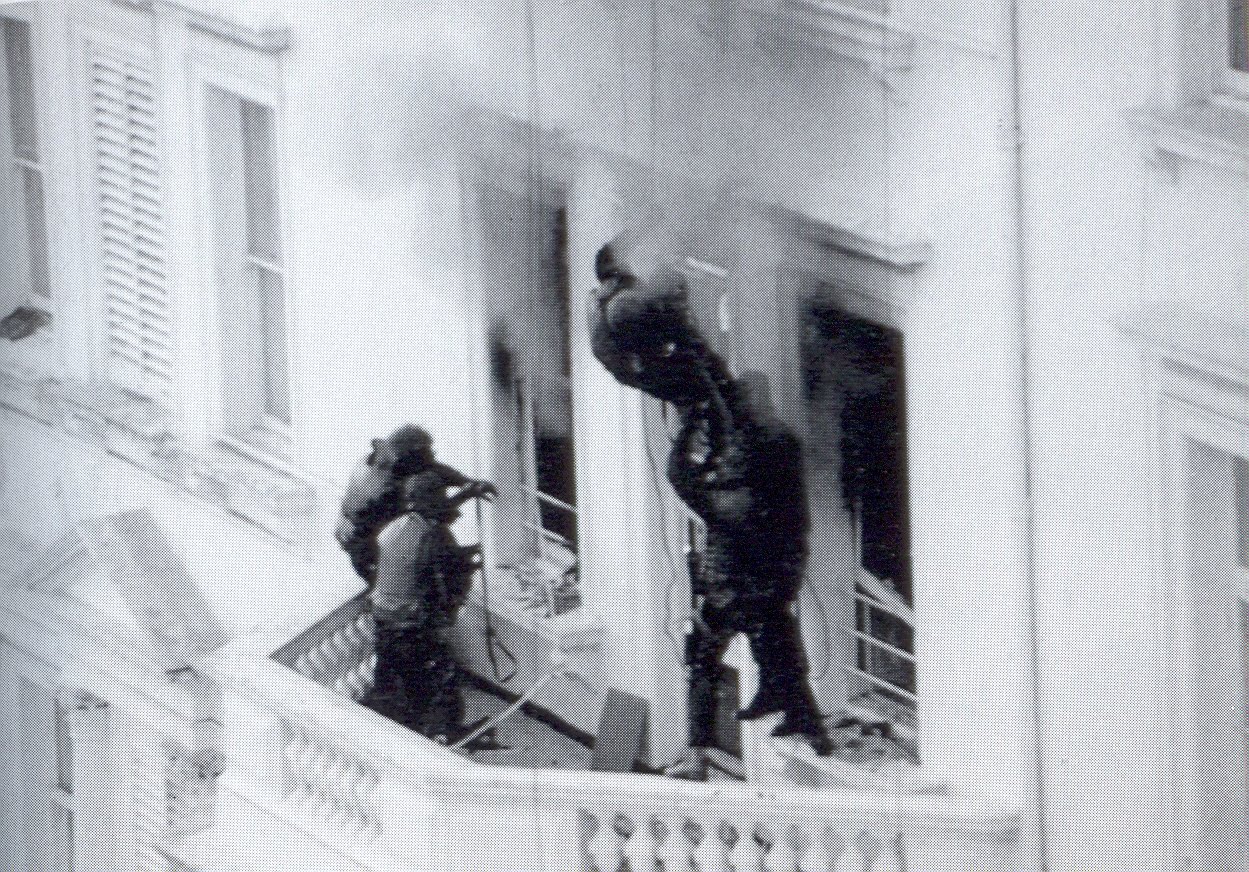
Members of the SAS have a popular image as gung-ho operators who shoot first and ask questions later: not really the type to create their own cocktails (or sport easy smiles). The use of tough SAS types in fiction has also become something of a cliché, with a whole genre being formed in the wake of Andy McNab's 1993 memoir of an SAS operation in Iraq, Bravo Two Zero. It's not quite James Bond territory. Or...?
In an article in Time published on November 10 2002, shortly before the release of Die Another Day, Lee Tamahori, the director of that film, made the following remark about the direction he felt the character had been taken in the previous few films:
‘“I was worried that he was turning into an SAS man, machine-gunning everyone,” says Tamahori. “I've been trying to make him more of an Ian Fleming Bond.”’This is a misapprehension. While copious use of a machine gun is not a hallmark of Ian Fleming’s novels, the idea that James Bond might be an SAS man is not out of keeping with them. In fact, Fleming included several clues that point to James Bond having just such a type of background.

'Pirbright was a mere hour from the attractions of London. During one lecture, possibly after a night at White's Club or the gaming tables, Stirling fell asleep. He probably fell asleep in many, but on this occasion he was woken by the lecturer, asking him to repeat what had just been said. Stirling repeated it verbatim.'1After this, Stirling volunteered for an expeditionary force setting off to fight a winter campaign in Finland – ski training was in Chamonix – before joining the commando group Layforce, after which he founded the SAS.
It is difficult to imagine a more 'James Bondish' background than this, but Stirling is one of the few leading commandos from World War Two not to have been claimed as a model for 007. Fleming was certainly inspired by the real-life experience of such men, however, as he made clear in an interview with Playboy published after his death:
'I think [Bond is] slightly more true to the type of modern hero, to the commandos of the last War, and so on, and to some of the secret-service men I've met, than to any of the rather cardboardy heroes of the ancient thrillers.'2

Fleming knew several heroic commandos and secret-service men who had served in the war. Perhaps the best known among them is Patrick Leigh Fermor, who worked for the Special Operations Executive (SOE) in Crete, where he led the party that kidnapped General Kreipe in 1944. That mission was immortalised in W Stanley Moss' book Ill Met By Moonlight, published in 1950, which was made into a film in 1957, with Dirk Bogarde playing Leigh Fermor.
In an afterword for the 2001 edition of Moss' book, Leigh Fermor wrote about the operation for the first time. He modestly refuted the 'Baroness Orczy - John Buchan - Dornford Yates' status that the episode has gained over the years, but at the same time revealed that during a prolonged stay in Cairo with SOE colleagues, the villa they had stayed in had been filled with gelignite disguised as goat's droppings, magnetised trouser buttons that turned into compasses and gossamer-thin maps stitched into the lining of clothing. Many of these items were created by a Major Jasper Maskelyne, who Leigh Fermor recognised as a stage magician he had seen perform in London as a child 3.
After the war, Leigh Fermor took up writing, drafting some of his first book, The Traveller's Tree, during a stay at Goldeneye in 1948. He loved Fleming's Jamaican retreat and commented in his book that it could become a model for new houses in the tropics 4. The two men became friends, and Fleming repaid Fermor’s plug for Goldeneye by quoting a long passage on voodoo from The Traveller's Tree in Live and Let Die.
Another of Fleming's friends mentioned in his novels was David Niven, whose manners Kissy Suzuki so admires that she names her cormorant after him. Niven also served as a commando of sorts in World War Two: while serving with 'Phantom', the regiment responsible for ferreting out information in forward areas and radioing it back to GHQ, he worked on joint operations with the SAS, whose command it came under from 1944 5.
Another friend, Antony Terry, was captured during Operation CHARIOT, the daring commando raid on the harbour installations at Saint-Nazaire in 1942, and was awarded the Military Cross for it 6. After the war, he worked for Fleming's Mercury News, as well as continuing his contacts with MI6, and in 1960, he guided Fleming around Berlin, helping him with much of the research for the short story The Living Daylights 7.
Closer to home, Ian Fleming's brother Peter was also engaged in commando work during the war. In 1940, he and 'Mad Mike' Calvert – who later found fame with the SAS – prepared for a guerrilla defence of Britain in the event of a German invasion. Later that year, Peter Fleming led a reconnaissance party into the Norwegian port of Namsos and the following year he formed and took a small commando team to Greece (the latter mission under the auspices of SOE). Neither expedition was a great success: Peter was reported to have been killed in Norway and an obituary even ran in The Daily Sketch, causing his family great distress until he arrived, alive and well, in Scotland. It may be that this episode later gave Ian the idea for Bond's false obituary in You Only Live Twice: it can be useful for a secret agent to have the world believe him dead.
In Greece, the Yak Mission, as Peter's group was nicknamed, wrecked the path of advancing German paratroops – Peter even booby-trapped a bridge by fitting a London double-decker bus with flame-throwers on it – before it was attacked from the air near the island of Milos. A 400-ton yacht that had been commandeered by the Navy burst into flames and sank, and Peter was again very lucky to come out alive 8.
Playing Red Indians

'Tell the Minister of Defence to have a midget submarine alongside the Harwich customs jetty not later than last light on Tuesday. It's important.’9The Sixth Column may have been a spur for Ian Fleming to knuckle down and write his own thriller, which he had been promising to do since the war: he started writing Casino Royale just a few months after the publication of his brother’s book. Archie Strume and Colonel Hackforth were partially based on the author Dennis Wheatley – who Peter had become friends with during the war – and his secret agent character Gregory Sallust, but the references to wartime commando adventures involving midget submarines may have been for Ian’s eyes only.
In 1942, Ian Fleming set up what he liked to call his ‘Red Indians’. No. 30 Assault Unit was a small roving commando outfit made up of men from the Army, Navy, Marines and Air Force. Its task was to go in after the first wave of Allied attacks and scavenge for technical intelligence: codes, weapons, equipment, maps and documents left behind by the Germans. The commanding officers were Dunstan Curtis, who had played a leading role in the Saint Nazaire raid, and the Antarctic explorer Quentin Riley 10.
One of 30 AU’s most enterprising officers was Lieutenant-Commander Patrick Dalzel-Job RNVR, who led missions in France, Belgium and Germany in the latter stages of the war. Dalzel-Job had an unusual background: after the death of his father in the Somme, he spent his formative years in Switzerland, where he learned to cross-country ski and speak French fluently. While still in his twenties, he built his own schooner and sailed to Norway with his middle-aged mother and a Norwegian schoolgirl as his crew.

Dalzel-Job did not care overly for his boss back in London, finding Ian Fleming cold, austere and egotistical, although he appreciated his ‘amusing and pungent’ minutes on operational intelligence reports 11. Dalzel-Job’s ‘Nelson touch’ even brought him into conflict with Fleming at the end of the war, when he sent a signal to the British Flag Officer in Oslo as though it were from the Admiralty, sending himself on a fairly pointless mission to Norway so he could find the schoolgirl he had sailed with before the war. Fleming was furious at not being consulted, and gave Dalzel-Job an earful about it, but off he went, found the girl, and married her.
Another member of 30 AU who saw action in France was Tony Hugill. Also a lieutenant-commander in the Royal Naval Volunteer Reserve , he was awarded the Croix de Guerre for his part in D-Day and won the Distinguished Service Cross for taking the surrender of 280 troops under a Luftwaffe officer at a radio station near Brest. From 1945-6, he led the Forward Interrogation Unit in Hamburg, Germany.
 After the war, Hugill went into the sugar industry, managing Tate and Lyle's West Indian operations between 1954 and 1966. In Fleming's last novel, The Man With The Golden Gun, Bond is vouched for by local sugar executive Tony Hugill, who, we learn in Chapter 4, was in Naval Intelligence during the war: 'sort of Commando job'. Bond's cover name for this mission, Mark Hazard, may have been inspired by the title of Hugill's war memoirs, The Hazard Mesh, published in 1946, but if so Fleming either hadn't read the book or was in a generous mood, because Hugill's depiction of him (although he is not named) is not flattering:
'One of the Admiralty pundits signalled us that he was about to honour us with a visit. We none of us liked him much. He was one of those very superior professorial type R.N.V.R.s who got their claws into Their Lordships early in the war and have kept them in ever since. As our proprietary deity he felt himself entitled to demand offerings of Camembert and libations of captured cognac of the better sort (But my dear feller this stuff's undrinkable!) from time to time. He also interfered with us on a higher level.'12In contrast to the popular perception of commandos today, the British commandos Fleming knew from the war were often, beneath their tough exteriors, cultured men of great sensitivity: Patrick Leigh-Fermor and Peter Fleming were both acclaimed travel writers, Tony Hugill’s memoirs are filled with poetry and Patrick Dalzel-Job’s autobiography is, at root, a love story.
Fleming never saw action in the field himself, although he may have liked to have done. John Pearson recounted in his biography that Fleming liked to tell people, Gatsby-ishly, that he had once killed a man, but that the story seemed to change with each telling 13, and some of his other claims of prowess have been similarly questioned.
This sense of inconsistency extended to James Bond. In his fiction, Fleming made use of those real-life episodes he found most fascinating and exciting; ensuring that all of his novels' re-imagined tidbits meshed together was of secondary concern. For example, Fleming fans the world over know that James Bond killed twice in cold blood to obtain his licence to kill – nobody cares to dwell on the irritatingly inconvenient sentence in Chapter 19 of From Russia, With Love in which Fleming baldly states:
'Bond had never killed in cold blood.'The two killings described in Casino Royale are both examples of operations usually undertaken by special forces: assassinations. Governments and conventional intelligence services cannot be seen to sanction extra-judicial murder, so such jobs inevitably fall to less accountable units. As Bond's second kill, in Stockholm, involved a Norwegian 'who was doubling against us for the Germans', it appears that both these missions took place during the war. According to MRD Foot’s official history of the SOE, Stockholm had been the initial base for that organisation’s activity in Scandinavia 14, so perhaps Fleming had heard of a similar operation through intelligence contacts and embellished it 15.
Bond's first 'wet job', in New York's Rockefeller Center, was inspired by Fleming's visit to the British Security Co-ordination's offices in the same building in June 1941; he accompanied BSC officers as they burgled a Japanese cipher clerk's office on the floor below theirs 16. The clerk was unharmed, but SOE, whose affairs in the Western hemisphere were controlled by the BSC in New York 17, did have an assassination capability. This was officially abandoned at the end of the war, but many SOE officers joined MI6, so the expertise may have remained in place 18. During the war, SOE operatives were commonly referred to as ‘terrorists’ by the Nazis; MRD Foot, who was a member of SAS during the war, recalls being captured and over-hearing one of his interrogators saying: ‘If he is a terrorist he is shot at once’ 19.
After the war, the SAS evolved into more of a counter-insurgency regiment; the 1969 Army Training manual stated that its tasks included 'the ambush and harassment of insurgents, the infiltration of sabotage, assassination and demolition parties into insurgent-held areas, border surveillance liaison with, and organisation of friendly guerrilla forces operating against the common enemy' 20. The SAS executed some of these responsibilities in the Mau-Mau rebellion in Kenya during the 1950s and in Aden in 1967 21. More recently, it has seen action in Aghanistan, Northern Ireland, Gibraltar and, latterly, Iraq.
Despite the above rather lurid description, members of the SAS have not always approved of assassination. When I asked former SAS sergeant Jacques Goffinet in 2005 if he had been tempted to assassinate Joachim von Ribbentrop when he discovered him in hiding in a flat in Hamburg in June 1945, he replied simply: 'That would have made me as bad as them.'22
James Bond is often concerned with the same dilemma: outside of the episodes mentioned in Casino Royale, he makes for a rather shaky assassin. In the short story Octopussy, he travels to Jamaica on a private war crimes investigation. His target is Dexter Smythe, who as a member of the Miscellaneous Objectives Bureau – a (fictional) wartime commando outfit formed by the Secret Service and Combined Operations – had murdered one of his early mentors. But while Bond had no qualms about murdering double agents or cipher clerks, this time he does not draw his weapon, leaving Smythe the options of suicide or disgrace.

The use of weapons

James Bond is neither straightforward assassin nor pure commando in Ian Fleming's novels: most of the time he works as a counter-espionage agent, sent by M to head off an emerging threat, rather than initiating offensive action against the enemy. Nevertheless, Fleming incorporated many details of war-time commandos into his novels: apart from the references to old colleagues and friends who had been involved in special forces, Q Branch's weapons and gadgets parallel the work done by similar departments in SOE and elsewhere. Bond's self-reliance and stamina are reminiscent of the commando ethic, as is his basic fitness regimen described in Chapter 11 of From Russia, With Love. His habit of taking Benzedrine was also common practice among commandos during the war, when remaining alert for long periods was often necessary.
Bond is also a martial arts aficionado – we know from M's obituary in You Only Live Twice that he founded the first judo class in a British public school. In Chapter 10 of the same novel, Tiger Tanaka tells Bond he will show him one of his service's secret ninja academies in the mountains, and Bond replies that MI6 also has a commando training school for unarmed combat attached to its headquarters. This is an example of Fleming carrying details across his books successfully, because in Chapter 8 of Moonraker Bond is happy to have his Unarmed Combat class with 'that dam' Commando chap' cancelled for a meeting with M. He is clearly a good student, though, because in the first chapter of Goldfinger we find him nursing the hand that has killed a Mexican with a 'Parry Defence against Underhand Thrust out of the book' and a hand-edge blow to the Adam's Apple that had been 'the standby of the Commandos'. A little later, in Chapter 5, we learn that Bond is writing Stay Alive!, a 'handbook of all methods of unarmed combat'.

The idea that this character has had some sort of experience with special forces is not implausible – but what form might that have taken? In his book The James Bond Dossier, Kingsley Amis wondered what a Commander from Naval Intelligence had been doing in the Ardennes sector in 1944 25 (which Bond recollects in Chapter Nine of Dr No). This may simply have been an oversight on Fleming's part, like the 'cold blood' boo-boo in From Russia, With Love, but it may also have been deliberate. In his obituary in You Only Live Twice, M tells us that Bond joined the Special Branch of the RNVR in 1941. Between that date and 1944, Peter Fleming undertook missions for both MI R and SOE; army intelligence officer Antony Terry was captured in a naval commando raid; RAF men took part in 30 AU's amphibious landings with Royal Naval Commandos; and Patrick Leigh Fermor and SOE colleagues arranged for guides to help Special Boat Service (SBS) officers across the mountains of Crete 26.
World War Two was a time of irregular warfare, and resourceful young men barging into offices in Whitehall demanding to mount their own raids against the Nazis were surprisingly common. Dozens of small commando units were formed, changed names or were subsumed into larger groups during the war, and as a result some enterprising men had extremely varied resumes by the cessation of hostilities. Churchill also set up Combined Operations under Lord Mountbatten, which ensured that commando groups worked together (like Dexter Smythe's outfit in Octopussy). For Operation FRANKTON, for example, a raid on Bordeaux Harbour in December 1942, the Royal Marine Boom Patrol's Detachment used limpet mines that had been developed by SOE 27 – or 'those things our saboteurs used against ships in the war', as Bond describes them in Chapter 15 of Live and Let Die (later in the book he attaches a limpet mine to the hull of the Secatur). FRANKTON was masterminded by Herbert ‘Blondie’ Hasler, who went on to play a leading role in the founding of the Special Boat Service (SBS), a sister service to the SAS. The operation was the subject of the 1955 film The Cockleshell Heroes, produced by Cubby Broccoli and co-written by Richard Maibaum.

However, the most plausible explanation would be that Bond was seconded to the SAS: it drew and still draws men from all armed forces (the 'Air' in its name was used to fit in with an earlier deception operation), and undertook several missions in the Ardennes during 1944 29. Fleming may have heard about one of these operations from David Niven or another friend who had worked with the regiment, and stored it away as being a suitable field of operation for Bond during the war. 30 AU also undertook reconnaissance work in Belgium at around this time.
Post-Fleming, 007’s special forces ties have often been emphasized: John Gardner – who served in the Royal Marines’ 42 Commando during the war – had Bond train with the SAS and the SBS in his novels 30, and the relationship has been even more overt onscreen: the closing scenes of many of the films, for example, are spectacular commando-like raids on villains' lairs. HALO jumps, bungee jumps, parachute landings and shooting while skiing are all areas of special forces expertise. Casino Royale continues the series' habitual nods to special forces work: as well as Vesper's appraisal, Bond holds up an embassy single-handedly and engages in plenty of hand-to-hand combat – he seems to have paid attention in his classes with that dam' Commando.

In his introduction to the 2005 edition of Jane’s Specal Forces Recognition Guide, Lieutenant-Colonel Ewen Southby-Tailyour, a veteran of four commando outfits, wrote that the dividing line between forces – military, police, special and elite, intelligence-gathering or other – is often blurred, especially in the military, and pointed to the then- (and still-) current geo-political climate as a catalyst for the increasing use of special forces’ unconventional methods:
‘It might now be argued that with the general proliferation of worldwide terrorism all military forces and most police forces should be trained for unconventional operations: certainly there should be considerably more awareness of, and training for, asymmetric warfare.’31The Bond novels and films have never purported to be plausible portrayals of clandestine work: they are fantastic adventures with one toe in the real world. James Bond is an amalgamation and elaboration of the most exciting bits of espionage and commando lore, filtered through the prodigious imagination of his creator. He is not, therefore, an out and out commando. But as a back story for the character, 'former SAS type' is not out of place: it is entirely fitting with his heritage.
I would like to thank MRD Foot and Lieutenant-Colonel Ewen Southby-Tailyour for their help and advice with this article.
References
1. p4 The Originals: The Secret History of The Birth of the SAS In Their Own Words by Gordon Stevens, Ebury Press, 2005.
2. The Playboy Interview: Ian Fleming by Ken Purdy, Playboy, December 1964.
3. pp193 and 205-206 Ill Met By Moonlight by W Stanley Moss, The Folio Society, 2001: afterword by Leigh Fermor.
4. p327 The Traveller’s Tree by Patrick Leigh Fermor, Penguin, 1984.
5. p139 The SAS: The Official History by Philip Warner, Sphere Books, 1983; and obituary of Captain Charles Moore, The Daily Telegraph, 13th May 2004.
6. p ix The Greatest Raid Of All by CE Lucas-Phillips, Little, Brown, 1960.
7. p371 Ian Fleming by Andrew Lycett, Phoenix, 1996.
8. pp221-227 and 239-255, Peter Fleming: A Biography by Duff Hart Davis, Oxford University Press, 1987.
9. p23, The Sixth Column by Peter Fleming, Tandem, 1967.
10. p134, The Life of Ian Fleming by John Pearson, Companion Book Club, 1966.
11. p115 Arctic Snow to Dust of Normandy: The Extraordinary Wartime Exploits of a Naval Special Agent by Patrick Dalzel-Job, Pen & Sword, 2005.
12. p60 The Hazard Mesh by JAC Hugill, Hurst & Blackett, 1946.
13. p210 Pearson.
14. p208 SOE: 1940-1946 by MRD Foot, BBC, 1984.
15. As well as his colleagues in Naval Intelligence, Fleming crossed paths with many people involved in clandestine work during the war. For example, on November 10 1942 he had dinner at the home of the thriller-writer Dennis Wheatley, who was then involved in devising deception operations with the Joint Planning Staff of the War Cabinet. Fleming was accompanied by Joan Bright, an assistant to General Ismay, Churchill’s Chief of Staff; the two other guests were Roland Vintras, also of the JPS and later a Director of Air Intelligence, and Colin Gubbins, later head of SOE. One can imagine that such dining partners may have given the future thriller-writer many ideas. Phil Baker (Wheatley biographer), personal communication. For more on this, and Wheatley's influence on Fleming's work, see my article The Secret Origins of James Bond.
16. p124 Pearson.
17. p42 Foot.
18. pp 611-612 MI6: Inside the Covert World of Her Majesty's Secret Intelligence Service by Stephen Dorril, Touchstone, 2000.
19. p57 Foot. James Bond is also described as a terrorist, of course, in his MGB file in Chapter Six of From Russia, With Love. Incidentally, Foot feels that Fleming was one of the few non-SOE officers in Britain’s wartime intelligence organisations to appreciate SOE’s worth (personal communication, November 17 2007).
20. British Army Land Operations Manual, volume 3, counter-revolutionary operations. Cited in British Intelligence and Covert Action by Jonathan Bloch and Pat Fitzgerald (London 1982), p42.
21. The SAS, their early days in Ireland and the Wilson Plot by Alexander Platow (Seán Mac Mathúna), first published in Lobster 18 (1989).
22. See Whisper Who Dares by Jeremy Duns, June 16 2005, The Bulletin, Brussels; reprinted in 5 SAS' Veterans' News, Issue 70, 2005, and at this site here.
23. p389 Jane's Special Forces Recognition Guide by Ewen Southby-Tailyour, Collins, 2005.
24. p47 British Commandos 1940-1946 by Tim Moreman, Osprey, 2006.
25. p17 The James Bond Dossier by Kingsley Amis, Signet, 1966.
26. p194 Leigh Fermor afterword, Moss.
27. p36 Cockleshell Heroes by CE Lucas-Phillips, Pan, 1974.
28. Granville has been repeatedly claimed to have been Fleming’s model for Vesper Lynd following a post-war affair with the author. The source for this appears to be p151 17F: The Life of Ian Fleming by Donald McCormick, Peter Owen, London, 1993. McCormick was a hoaxer, notably on matters related to Jack the Ripper, and I believe that he fabricated the evidence for this plausible-sounding assumption. Regardless, there seem very few similarities between Granville and Vesper Lynd other than their both being beautiful female agents with dark hair.
29. Ewen Southby-Tailyour does not agree with me on this point, being adamant that Fleming’s Bond would have been more likely to have been SBS than SAS. He points to Bond’s naval background and the fact that every member of the SBS was trained in skiing, parachuting, mountaineering and combat (underwater) swimming – but very few members of the SAS undertook training in all of these (personal communication). However, the SAS often collaborated and exchanged personnel with naval units during the war, and the SBS never undertook any operations in the Ardennes.
30. p15, Icebreaker by John Gardner, Berkley, 1983; and p28 Scorpius by John Gardner, Charter, 1990.
31. pp6-7 Introduction, Jane's Special Forces Recognition Guide.


